The Royal New Zealand Army Ordnance Corps (RNZAOC) and its predecessors were responsible for crucial storekeeping duties, ensuring the supply of Clothing, Camp Equipment, Ammunition, Arms, and Accessories to New Zealand’s Military Forces. As the Second World War unfolded, the complexity of military storekeeping transformed dramatically, encompassing a wide array of military equipment, including vehicles, communications gear, and mechanical plant. These new assets were deployed in massive numbers and necessitated many accessories and intricate repair parts to keep them operational. To streamline control and provide an optimal system, the RNZAOC implemented significant measures in 1963. They established RNZAOC Stores Sections within the Royal New Zealand Electrical and Mechanical Engineer (RNZEME) workshops. In addition, the Auto Parts trade was initiated in 1965, reinforcing the overall process. This article offers an enlightening and sweeping overview of how the Mechanical Transport Branch (MT Branch) and the RNZAOC effectively managed Mechanical Transport Stores (MT Stores) from 1939 to 1963.
In 1939, as the New Zealand Army mobilised, it aimed to seamlessly integrate into a larger British army, much like in the First World War. The British army had already embraced modern technology, making it highly motorised and technologically advanced so that ‘By the time of the invasion of Poland, the British Army in Europe was rather more motorised than the German Army.’[1]. Some aspects of this advanced doctrine made its way to New Zealand in the late 1930s with modern equipment like Bren Guns and Universal carriers. The army had even conducted some basic experiments in motorisation. However, due to interwar defence policies and financial constraints, the New Zealand Army Ordnance Corps (NZAOC) was not efficiently organised like its counterpart, the Royal Army Ordnance Corps (RAOC), in the United Kingdom. Consequently, the NZAOC was unprepared to function effectively when the war began.
During the Second World War, it was as if New Zealand maintained two separate armies. The first was the 2nd New Zealand Expeditionary Force (2nd NZEF), fully equipped with combat units, supporting arms, and logistic units. These forces were organised according to modified War Office Establishment tables, with G1098 stores directly drawn from British stocks. [2] The second army was the NZ Army at home, also organised according to War Office Establishment tables. However, a New Zealand logistical base provided its equipment needs and G1098 Stores.
This dichotomy in organisation and preparedness highlighted New Zealand’s challenges as it strived to align itself with modern military practices while operating within the constraints of its resources and policy decisions.
In 1939, the NZAOC was constrained by interwar defence limitations, primarily focusing on supplying and maintaining clothing, equipment, ammunition, and weapons. Despite the army possessing 56 vehicles, the NZAOC lacked substantial experience in supporting Mechanical Transport (MT) at the scale the rapidly growing army required. Most senior leadership had been seconded to the 2nd NZEF, which hindered the NZAOC’s ability to expand effectively during the critical early wartime years.
Recognising the urgent need to expand and manage the Army’s MT fleet, the Quartermaster General (QMG) took a bold step away from convention and established a separate MT Branch. This move allowed the NZAOC to focus on its core responsibilities. At the same time, the MT Branch managed and maintained the multitude of purchased or impressed vehicles required by the military.
Drawing inspiration from the Royal Army Ordnance Corps (RAOC) in the United Kingdom, the MT Branch wisely leveraged the expertise of the New Zealand Motor industry. Many of its staff were directly recruited from the motor industry into the New Zealand Temporary Staff (NZTS), ensuring a wealth of specialised knowledge and experience was brought to the forefront of this critical military function. During the early years of the war, the NZ Military primarily relied on civilian vehicles impressed into service. They initially purchased existing stock from New Zealand’s motor manufacturers and dealerships to ensure an adequate supply of MT spares. However, as the war continued, the influx of new vehicles, equipment, and spares from the United Kingdom, Australia, Canada, and the United States necessitated significant expansion of the MT Branch.
New Zealand Temporary Staff. Robert McKie Collection
MT Workshops
1 MT Workshops, Trentham
2 MT Workshop, Waiouru
3 MT Workshops, Papakura
4 MT Workshops, Whangarei
5 MT Workshops, Palmerston North
6 MT Workshops, Wellington
7 MT Workshops, Blenheim
8 MT Workshops, Burnham
9 MT Workshop, Dunedin
MT Depots providing pools of vehicles.
1 MT Depot, Auckland
2 MT Depot, Hamilton
3 MT Depot, Napier
4 MT Depot, Wanganui
5 MT Deport, Christchurch
MT Stores Depots providing MT spares, tools and equipment for MT Workshops and Depots
1 Base MT Stores Depot, Wellington
2 MT Stores Depot, Auckland
3 MT Stores Depot, Wellington
4 MT Stores Depot, Christchurch
7 MT Stores Depot, Blenheim
Freed from the burden of managing MT, the Chief Ordnance Officer (COO) with NZAOC, Territorial units of the New Zealand Ordnance Corps (NZOC) and personnel from the NZTS would provide.
All natures of stores and equipment, other than rations, forage, and fuel.
The repair and maintenance of armaments and equipment, including.
Light Aid Detachments and mobile workshops to provide 1st and 2nd line support across Field Force Units
Armament and General Engineering Workshops.
Main Ordnance Workshop, Trentham
11 Ordnance Workshop, Whangarei
12 Ordnance Workshop, Devonport
13 Ordnance Workshop, Blenheim
14 Ordnance Workshop, Burnham
15 Ordnance Workshop, Dunedin
As of 31 March 1944, the MT Stores Depots had undergone significant reorganisation and successfully handled the following quantities of Tyres and MT Parts:
180 different sizes of Tyres
Purchased from overseas – 83174.
Purchased in New Zealand – 12534
Total Purchased – 95708
Transferred to Supply Department – 11018
Other issues – 28700
In stock 31/3/1944 – 55990
Reserved for Supply Department – 2000
General – 35990
Used tyres recapped and re-treaded – 9983.
Reconditioned tyres reissued – 7301.
Reconditioned tyres in stock 31 March 1944 – 2682
M.T. Parts. (Not including body-building material)
Received from overseas (Total of 9182 Tons)
Wheeled vehicles, parts- 20472 Packages
Tracked vehicles, parts – 39408 Packages.
Tracked vehicles, tracks – 8280 Bundled.
Packages broken down and binned – 23895.
Packages transferred to United States Forces – 1050
Packages in Bulk Store – 43215
Shipments of MT Parts and Tyres to the Pacific
3 Division – 1149 Tons
Fiji – 406 Tons
Tonga – 112 Tons
Norfolk – 30 Tons
1944 MT Stores Organisation
Base MT Stores Depot, Wellington.
8 Officers
103 Other Ranks
Depot No 7, 186-200 Wakefield Street, Wellington, Rented, 3353 Square Meters, Main Base Store for parts, tools, etc. Administrative Offices.
Depot No 8, 102 Wakefield Street, Wellington, Rented, 1115 Square Meters, Bulk Tyre Store.
Depot No 9, 97 Taranaki Street, Rented, 1300 Square Meters, Parts etc for AFV.
Depot No 10, Cable Street, Wellington, Rented, 1821 Square Meters, Bulk part store.
Depot No 11, George Street, Wellington Rented, 238 Square Meters, Bulk store for heavy parts, AFV.
Depot No 11, Taranaki Street, Wellington, Rented, 186 Square Meters, Bulk stores for heavy parts, AFV.
Depot No 12, Coutts Street, Kilbirnie, Rented, 232 Square Meters, Bulk store for body-building material.
Depot No 13, 129 Tory Street, Wellington, Rented, 279 Square Meters, Bulk Store – Steel
Depot No 14, Gracefield, Petone, Govt Store, 1542 Square Meters, Bulk Store – General
Depot No 15, Gracefield, Petone, Govt Store, 1579 Square Meters, Bulk Tyre Store
Depot No 15, Kent Terrace, Wellington, Rented, 881 Square Meters, Bulk Tyre Store
Depot No 16, Gracefield, Petone, Govt Store, 1412 Square Meters, Bulk Store – General
Depot No 17, Gracefield, Petone, Govt Store, 1709 Square Meters, Bulk Store – General
Depot No 18, General Motors, Petone, Special, 743 Square Meters, Parts Store – GM Products
Depot No 19, General Motors, Petone, Special, 743 Square Meters, Parts Store – Ford Products
Depot No 21, Gracefield, Petone, Govt Store, 1951 Square Meters, Bulk Store – General
“Advanced Base Stores Depot, Northern Military District
1 Officer
26 Other Ranks
Depot No 2, Hood Street, Hamilton, Rented, 809 Square Meters, Parts and Tyres
Depot No 3, Drill Hall, Hamilton, Government, 372 Square Meters, Bulk Store
Advanced Base Stores Depot, CentralMilitary District
1 Officer
17 Other Ranks
Depot No 4, 83 King Street, Palmerston North, Rented, 650 Square Meters, Parts Store
Depot No 5, Showgrounds, Palmerston North, Rented, 1338 Square Meters, Tyres and bulk parts.
Depot No 6, Palmerston North, Rented, 310 Square Meters, Bulk Parts
Advanced Base Stores Depot, Southern Military District
1 Officer
21 Other Ranks
Depot No 26, Kilmore Street, Christchurch, Rented, 986 Square Meters, Parts and Tyres
Depot No 27a, Litchfield Street, Christchurch, Rented, 418 Square Meters, AFV Parts
Depot No 27b, Christchurch, Rented, 465 Square Meters, Used Tyres.[4]
Post War
Before the war, the NZAOC was not effectively organised to fulfil its functions. However, after the war, there was an opportunity to reorganise the NZAOC to align it with the organisational structures and procedures of the RAOC (Royal Army Ordnance Corps), which included the management of vehicles and MT Spares. Originally intended as a temporary wartime organisation, the MT Branch would have its wartime responsibilities integrated into the reorganised NZAOC. Additionally, a newly established NZEME (New Zealand Electrical and Mechanical Engineers) would take on specific roles as part of the overall restructuring.[5]
MT Workshops
From 1 September 1946, the MT Branch Workshops and the Ordnance Workshops were integrated into the newly established NZEME organisation.[6]
MT Vehicle Depots
Following the return of many impressed vehicles to their original owners or their disposal during the war, the MT Vehicle Depots were left with a significant inventory of military vehicles. To streamline operations, responsibility for the MT Vehicle Depots was transferred to the RNZAOC on 1 September 1947, establishing the RNZAOC Vehicle Depots at Sylvia Park, Trentham, and Burnham.[7]
MT Spares Depots
On 1 April 1948, after conducting multiple audits and stocktakes, MT Stores handed over spare parts, tools, and accessories to the RNZAOC. To ensure smooth management of MT Stores, the RNZAOC established MT Spares Groups at the Main Ordnance Depot (MOD) in Trentham and the Northern and Southern District Ordnance Depots.
The supply system for MT Stores involved RNZEME workshops holding a small stock managed by RNZEME Stores Staff. Replenishment was through Local Purchase or the supporting District Ordnance Depot, MT Group. An exception existed with the Central Districts Workshops at Waiouru and Linton, which demanded supplies directly from the MOD MT Stores Group at Trentham. This issue was resolved in 1954 when the Central Districts Ordnance Depot at Linton was authorised to establish an MT Stores Depot, streamlining the process.
By 1961, the NZ Army vehicle fleet underwent a significant transition, with the older World War Two era vehicles, including Chevrolets, Fords, and GMCs, being replaced by a modern fleet of Bedford’s and Land Rovers. As the vehicle fleet transitioned, the management of MT Stores was also reviewed, leading to several changes implemented between 1961 and 1962.
Workshop Stores Sections
A transformative era commenced in 1962, as the RNZAOC Workshop Stores Sections emerged as integrated powerhouses within the following RNZEME Workshops:
Northern Districts Workshops
Central Districts Workshops
Central Districts Armament and General Workshops
Central Districts MT Workshops
Southern District Workshops
This momentous shift witnessed 50% of the new Stores Sections’ staff comprised of RNZEME personnel, transitioning into the RNZAOC, heralding an unparalleled synergy, propelling these sections to new heights of efficiency and effectiveness. Thus, a legacy of innovation and collaboration was born, forever changing the landscape of logistical excellence.[8]
Ordnance Deport MT Stores Groups
A transformative restructuring unfolded with the inception of RNZAOC Stores Sections, triggering a series of cascading changes. The District Ordnance Depot, MT Stores Groups, underwent a reroll, transforming into Technical Stores Groups, relinquishing their hold on MT Stores with MT Stores stocks reallocated to the new Stores Sections, initially equipped with a six-month inventory, later streamlined to three months from January 1963. Any surplus stock from the District Ordnance Depots found a new home in the MOD, optimising resource allocation.
By the close of 1963, RNZAOC Stores Sections had firmly established their presence within the RNZEME Workshops. Beyond merely providing MT Spares, they evolved to encompass a comprehensive array of repair parts and spares essential for workshop operations. Within the RNZAOC, these sections fostered their distinct identity and culture, paving the way for introducing the RNZAOC Auto Parts and Accessories trade in 1965.
Conclusion
The RNZAOC and its predecessors played a vital role in storekeeping duties, supplying essential items to New Zealand’s Military Forces, including clothing, camp equipment, ammunition, arms, and accessories. During the Second World War, military storekeeping became more complex, involving various military equipment, vehicles, communications gear, and mechanical plant.
The MT Branch had managed MT Stores during the war, but post-war reorganisation integrated these responsibilities into the RNZAOC. Additionally, the NZEME assumed specific roles within the restructuring. To streamline operations, the RNZAOC implemented significant measures in 1963. They established RNZAOC Stores Sections within the RNZEME workshops, integrating RNZEME Stores personnel into the RNZAOC. This move facilitated unmatched synergy and efficiency, transforming the logistical landscape.
Overall, the RNZAOC Stores Sections became an integral part of the RNZEME workshops, providing not only MT Spares but also a full range of repair parts and spares. This collaboration fostered a unique culture and set the stage for introducing the RNZAOC Auto Parts and Accessories trade in 1965. The RNZAOC’s evolution enhanced logistical excellence and efficiency, significantly impacting New Zealand’s military operations.
Notes
[1] Jonathan Fennell, Fighting the people’s war : the British and Commonwealth armies and the Second World War, Armies of the Second World War, (Cambridge University Press, 2019), Non-fiction, 32.
[2] Army Form G1098, the Unit Equipment Table giving the entitlement to stores and equipment.
[3] “Staff – Motor transport branch,” Archives New Zealand Item No R22438851 (1942).
[4] “Appendices to Report on QMG (Quartermaster-General’s) Branch,” Archives New Zealand Item No R25541151 (30 June 1944), .
[5] “Organisation – Policy and General – Royal New Zealand Army Ordnance Corps 1946-1984,” Archives New Zealand Item No R17311537 (1946).
[6] The NZEME would gain royal status in 1947 as the Royal New Zealand Electrical and Mechanical Engineers (RNZEME).
[7] Peter Cooke, Warrior Craftsmen, RNZEME 1942-1996 (Wellington: Defense of New Zealand Study Group, 2017), 189.
[8] “Organisation – Policy and General – Royal New Zealand Army Ordnance Corps 1946-1984.”
June 2021 was a significant month for the New Zealand Army, the Royal New Zealand Army Ordnance Corps (RNZAOC), and its successor, the Royal New Zealand Army Logistic Regiment (RNZALR). This month marks the one-hundredth anniversary of the establishment of Burnham Camp. It also celebrates the continuous presence of one unit at Burnham since 1921: the NZAOC Ordnance Depot, now 3 Catering and Supply Company, RNZALR.
The site where Burnham Camp now stands was originally the Burnham Industrial School for neglected and delinquent children, established in 1875. The Territorials used it as a training site from 1914, and it was recommended in 1918 that the school and grounds continue to be used for future Territorial Force annual camps.
Burnham Industrial School. Archives New Zealand Reference: photographs CH438/1
The Industrial School closed in 1918. With wartime training ceasing, the need for a permanent army camp to act as a mobilisation centre in the South Island was recognised. Burnham’s facilities served the Army well during the war, prompting negotiations to transfer the industrial school buildings and land from the Education Department to the Defence Department.
On 11 September 1920, the Education and Defence Departments agreed to hand over the Burnham Industrial School to the Defence Department for use as a military training camp and ordnance depot.
Since 1906, the NZAOC had maintained two mobilisation and ordnance stores in the South Island to support the southern military districts. One store was located at King Edward Barracks in Christchurch, and it was responsible for the Canterbury and Nelson Military District. The other was in St Andrew Street, Dunedin, serving the Otago and Southland Military Districts. Post-war reorganisation of the New Zealand Military Forces and the arrival of new military equipment from the UK led to the establishment of a South Island Ordnance Depot at Burnham. On 15 November 1920, the NZAOC took over the existing Education Department buildings at Burnham for an ordnance depot. Concurrently, approval was granted for a new North Island Ordnance Depot at Hopuhopu to serve the Northern Military District.
With the closure of the Dunedin store and the imminent transfer of stores from the North Island, establishing the new ordnance depot became urgent. Accordingly, £500 (2021 NZD 48,639.23) was approved in November 1920 for purchasing and erecting shelving. An additional £600 (2021 NZD 58,367.07) was approved for erecting new buildings, including twenty-five from Featherston Camp and relocating Buckley Barracks from Lyttelton for use by the ordnance depot.
As the Canterbury and Nelson Military Districts and the Otago and Southland Military Districts were combined into the Southern Military Command, Captain Arthur Rumbold Carter White was appointed Ordnance Officer Southern Command on 27 May 1921. White was appointed Defence Storekeeper for the Canterbury District in 1906. He was reclassified as the Assistant Director of Equipment and Ordnance Stores, granted honorary rank in February 1916, and commissioned as Captain in the New Zealand Army Ordnance Department (NZAOD) in 1917.
With the transfer between the Education and Defence Departments finalised on 31 May 1921, Major E. Puttick of the NZ Staff “Q” Duties formally received the property and buildings of Burnham Camp from the Education Department. Confirming Burnham’s status as a New Zealand military camp, General Order 255 of 20 June 1921 appointed Captain A.R.C. White, NZAOD, as the first Commandant of Burnham Camp, a position he would hold until 1930.
Captain A.R.C White NZAOC. M.Dart/Public Domain
The ordnance depot remained in the Industrial School buildings until 1941, when a purpose-built warehouse and ammunition area was completed. Since 1921, Burnham Camp has undergone many transformations and remains, one hundred years on, the South Island home of the NZ Army.
Despite many units coming and going from Burnham Camp, the only unit to retain a constant presence has been the Ordnance Depot. Over the past century, as the nature of logistic support and its delivery have evolved, the original Ordnance Depot has undergone many reorganisations, role, and name changes, including:
1921-1942, Southern Districts Ordnance Depot
1942-1948, No 3 Ordnance Sub Depot
1948 was renamed and split into
Southern Districts Ordnance Depot (SDOD)
Southern Districts Ammunition Depot (SDAD) and
Southern Districts Vehicle Depot (SDVD)
1961 SDOD reorganised to include the SDVD and SDAD
1968 Renamed 3 Central Ordnance Depot (2 COD)
16 October 1978 Renamed to 3 Supply Company
1990 Renamed to 3 Field Supply Company
9 December 1996 became 3 Supply Company, Royal New Zealand Army Logistic Regiment (RNZALR)., and later renamed 3 Catering and Supply Company, RNZALR
Although other corps and regiments have been tenants at Burnham Camp, the Ordnance Store has been a constant and unbroken tenant from 1921 as an NZAOC unit, then an RNZAOC unit, and now an RNZALR unit. This service record in one location is unmatched by any other unit of the New Zealand Army.
RNZAOC Ammo Techs who served in Singapore will be familiar with the area described in this article. Then known as Attap Valley the NZAOD maintained three Explosive Storehouses in this complex from 1974 to 1989.
In the years leading up to 1914, the New Zealand Military Forces underwent a significant transformation. Under the Authority of the Defence Act 1909, the old volunteer system was abolished, and a new military framework supported by universal Military Service by all males between certain ages was established. The evolution of New Zealand’s Military and how General Godley and his Cadre of Imperial and local Military Officers and Non-Commissioned Offices created a modern, well equipped Army is well recorded. However, it is the role of the Defence Stores in which has remained anonymous. A component of the New Zealand Military since the 1860’s the Defence Stores would furnish the equipment for multiple mobilisation and training camps and equip thousands of men with uniforms, arms, and ammunition on the mobilisation of New Zealand in August 1914. The culmination of the Defence Stores effort would unknowingly be validated by Military Historian Glyn Harper who in his 2003 book Johnny Enzed states; [1]
In all aspects of required military equipment, from boots and uniforms to webbing, ammunition and weaponry, in 1914 New Zealand had ample stocks on hand to fully equip the Johnny Enzed’s of the Expeditionary Force.
Although the Defence Stores was an active participant in the lead up to the First World War, it has been the victim of a pattern of amnesia which had virtual wiped its existence and contribution from the historical narrative.
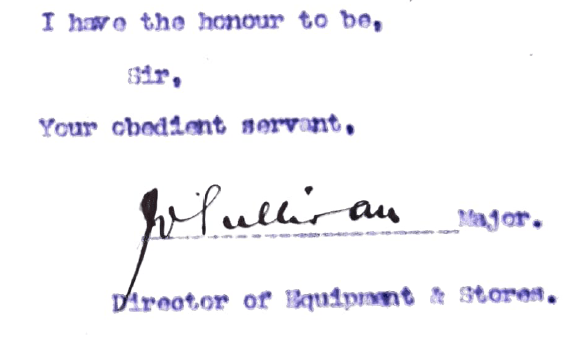
Under the management of Major James O’Sullivan, the Director of Equipment and Stores, the 1914 Regulations for the New Zealand Military details that the Defence Stores were[2]
responsible for the supply of clothing, equipment, and general stores; supplies of stationery, forms, and books; supply of, all vehicles and technical equipment, excepting Artillery and Engineers; storage and distribution of small-arms, accoutrements, and camp equipment’s, Customs shipping entries, and ammunition.
The following report was produced by Major O’Sullivan and details the activities of the Defence Stores up to 31 March 1914 and provided a useful appreciation of how the Defence Stores were placed prior to the mobilisation in August 1914.
NEW ZEALAND MILITARY FORCES.
REPORT OF THE DIRECTOR OF EQUIPMENT & STORES FOR THE YEAR ENDING 31 MARCH 1914
The Quartermaster-General Headquarters N.Z. Military Forces Wellington
Sir,
I have the honour to report as follows on the Stores, Magazines and Equipment in the Dominion for the year ending 31st March 1914.
SMALL ARMS AMMUNITION
The reserve of Small Arms Ammunition .303 Ball has since my last report increased by 138,000 rounds. The quality has maintained its excellence, and no complaints of any moment have been received during the year. the increased supply of cordite ordered has been received, thus removing any danger through delays in shipment. This will build up a reserve of cordite, which will be available to keep the Factory fully employed in the event of short shipments usually caused through Strikes in gland.[3]
The question or an increased reserve of Ammunition is a policy matter, but I wish to point out that the large increase in our Smal1 Arms during the year, consequent upon the importations from Egeland md Canada, has proportionately reduced the number of rounds available per Rifle.
The total issue of .303 Ball Ammunition during the year was 4,I62,000.
SMALL ARMS
During the year, 30,000 Rifles M.LE. Long were imported into the Dominion, 15,000 being from England and 15,000 from Canada. Of the English, 5,000 were perfectly new arms, while the 10,000-part worn were in such good condition that except to an Armourer or one very familiar with Arms, they appeared to be quite new.
The former were purchased at £2 each and the later at were purchased at £1, and as the landed cost of a new M/L.E. Rifle Long has hitherto been £3/12/. it can readily be calculated what an immense saving their purchase meant to the Dominion.[4]
CANADIAN RIFLES
The Canadian Rifles arrived in various shipments, the cost in Canada to the Department being 4/2d.landed cost 5/. Each. These Arms were not, of course, expected to be in the same condition as the English Rifles, having been thoroughly oiled prior to despatch front Canada, On arrival in the Dominion, however, after being overhaled and thoroughly cleaned by the Armourers, it was found that the Ars were in excellent condition, less than 2% requiring rebarrelling, while a fair number were quite new. Sword Bayonets and Scabbards patten “88 were also supplied with these Arms, while the Arms Chests in which they were packed, were in excellent order.
At 4/2d each, these Arms were a wonderful bargain, especially when it is remembered that a Rifle Bolt alone costs in England I6/. If any more of these rifles are obtainable, I would recommend that another five thousand be purchased, as they will be required if it is intended to train the General Training Section of the Reserve, it would be a waste of money to issue new Rifles to these if they are allowed to keep them in their homes, as they would very soon go astray or become unserviceable, while even if a percentage of the Canadian Rifles were lost, the actual financial loss would no be great.
The whole of the above Arms were received during the months of January, February and March and were immediately issued to the Senior Cadets, who are now fully armed.
No Protectors, Bottle Oil, or Pullthroughs were received with the Canadian Arms, but a supply has been cabled for, which, on arrival, will be issued.
We have in stock about 8,000 new spare barrels for Rifles M.L.H. Long, which means that 13.3% of the Rifles in the Dominion could be rebarrelled at short notice. It is, perhaps, just as well that we have a good reserve, as it is very probable a number of the rifles on issue to Cadets will be neglected.
The total number of Rifles M.L.E Long at present in Store and on issue to the forces is about 46,000.
RIFLES M.L.E. SHORT
The total number of Rifles M.L.E. Short in the Dominion is 13,810. These are on issue to Mounted Rifles, Field and Garrison Artillery, Field Engineers and Coast Defence troops, except about 1,900 of the Mk I pattern on issue to Senior Cadets and which are now being recalled.
Our reserve of Barrels and Spare parts is in about the sane proportions as for the Rifles M.L.E.Long.
RIFLES MARTINI-ENFIELD
There are in all about 1,100 of these in the Dominion. They are on issue to Senior Cadets, but are being recalled, so the question of how they are to be utilised will be for your consideration.
RIFLES .310
There are 1,052 of these, which were taken over from the Education Department, and issued to Senior Cadets in Auckland District. They were, however, condemned by District Headquarters as being useless for Musketry, and are being returned to Store. The question of what is to be done with these and the 928,000 rds of .310 Ball Ammunition will have to be considered later.
CARBINES
There are in the Dominion about I,400 M.L.E and 2,500 M.E Carbines, which are principally on issue to Colleges and High School Senior Cadets. There are, however, complaints of the poor shooting made with these in comparison with that with the Rifles on issue to other Senior Cadet Companies. Demand have therefore been made for Rifles to replace the Carbines, and in some cases this has been done, while the remainder will be replaced during the current year. The question of what to do with the replaced Carbines will therefore require consideration.
REVOLVERS
We have about 900 Revolvers in stock. These are of an obsolete pattern known as Dean and Adams, which were imported about thirty years ago. In fact, it is impossible to obtain ammunition for them, as the Webley Pistol Cordite Ammunition will not fit. There is a quantity of about 9,000 rounds of powder-filled ball for these Revolvers imported in 1880, but it ss not reliable. There are also about 14,000 rds Cordite filled ball, but this does not properly fit the Revolvers.
RIFLES SOLD TO DEFENCE RIFLE CLUBS.
The aforegoing Arms do not include the 3,423 Rifles M.L.E.Long and the 2,719 Rifles M.E. sold to members of Defence Rifle C1ubs. These are the property of the members, but no doubt practically the whole of these would be available in an emergency.
ACCOUTREMENTS
As mentioned in my last annual Report, an additional supply of Mills Web equipment was required, and in September 1913 demand was made for 4,000 sets and 20,000 Tools entrenching with Carriers, but approval for the expenditure was not obtained until the end of March this year. When these arrive from England, the equipment of the Infantry Regiments will be completed.
During the year all Brown Leather Accoutrements were called in from Field Engineers and Garrison Artillery, and replaced with Mills Web Modified pattern equipment consisting of Belt, waist: 2 Pouches and Frog This was considered to be a more suitable equipment for these units, besides which a considerable saving in expenditure was effected.
The Railway and Post and Telegraph Battalions and the Army Service Corps Companies have since been similarly equipped.
So far, no improved equipment for Mounted Rifles has been devised, our own Bandolier equipment, which has given satisfaction, is still being used.
As the whole of our Bottles Water Mk.IV are unfit for further service an additional supply of Bottle Water MK.VI with sling, carriers, has been ordered to complete equipment of Mounted Regiments and Ordnance Units. A further supply of Slings, Web, is also under order.
The Belts, Waist, Web, devised for Senior Cadets, which are made in the Dominion as a cost of 6d each, are giving general satisfaction.
SWORDS, OFFICERS & SAM BROWNE BELTS.
Owing to all Officers now being given an issue of a Sword and Sam Browne Belt on First Appointment, a large number of these are annually required. Of course, the number issued this year is greater than wi1l be that of subsequent issues. Taking free issues and sales during the year, there were issued 372 Swords 800 Sam Browne Belts.
MAXIM MACHINE GUNS.
As Mentioned in my last Annual Report, one each Maxim Machine Gun mounted on Tripod with Pack saddlery complete, was issued to Mounted and Infantry Regiments, and a supply of Tripods ordered to convert the Maxim Guns mounted on Field Carriages to Pack saddlery. The Maxims on Field Carriages were called into Store, but it was ascertained before these Guns could be properly fitted to Packsaddles, a number of suitable stores were required from England. These are now under order from England and on arrival. The conversion proceeded with. The addition of one Regiment of Infantry to the original establishments leaves us deficient of two Machine Guns, as no provision j=had been made for creases, and no spare Guns had been ordered. It will therefore be necessary to consider if two more Guns with Pack saddlery complete should be ordered.
If it is intended to equip Coast Defence Infantry in Auckland, Christchurch and Dunedin, or other Units, with machine Guns, a further order will be necessary.
During the year, three of the service locks which were broken were sent to England to be repaired and reported on. The locks have been returned and re-issued, and the report from England states that the breakages due to over tempering of the steel part in construction. As no further breakages were reported, it is presumed that only these three locks were faulty.
UNIFORM EQUIPMENT 1913/14.
TERRITORAL & SENIOR CADET
During the year the clothing of territorials and Senior Cadets has been continued steadily and at the end of March, with the exception of Caps, Forage, all clothing demands were completed.
The supply of Greatcoats and Putties, which I mentioned in my last Report as being in a backward condition, has now been brought up to date, and all branches of the service have been fully suppled as demands came forward.
A considerable saving was effected through the importation from England of some 10,000pairs Imperial Service Putties at a cost of about 3/. per pair, as against the price required for a local made article – which being all wool did not give satisfaction – and which cost about 4/9d per pair.
With the exception of Greatcoats, of which some 5,500 were received from Southern Firms, a Wellington Firm secured the contract for suppliers of Territorial Clothing, and they have made deliveries without delay thus enabling the Department to issue immediately on receipt of Requestions from Regiments.
The quality of material and make of garments has been fully maintained, and no complaints whatever have been received in this respect.
The delay in delivery of Caps, Forage, has been owing to there been no Factory in the Dominion which make the waterproof material as laid down in specifications of new Contract, and the supplies of this material had therefore to be obtained from England. Owing to Strikes and other causes the Contractors experienced great difficulty in obtaining supplies in time to meet our requirements.
Every effort has been made to keep down expenditure in connection with Uniform Clothing – no order has been placed with Contractors in excess of actual requirements – and though in some items the minimum number we were required to take under the Contract has been exceeded, this was owing to short deliveries under Contracts for 1911/13, and the formation of the Army Service Corps and Railway Battalions, which necessitated distinctive Uniforms being made.
The position of Uniform Clothing for year ending 31st March 1914 is:-
When it is remembered that there are Uniforms stocked for the six branches of the service, each of which are again divided in 31 different sizes, the total number in store is not large, and unless maintained, it would be impossible to issue the particular sizes asked for on requestions received, nor would we be able on a sudden emergency to meet demands.
SENIOR CADET UNIFORMS.
The issue of Clothing to senior Cadets has been steadily maintained during the year, and on 3Int March 1914, all Requisitions for Clothing received had been supplied on that date. The quality of material and the make of the uniform reflects credit on the Contractors.
As with the Territorial Uniform, only the particular sizes of garments of which our stocks were nearly exhausted, were ordered, and the minimum quantity under contract was not taken during the year. As far as possible, all Trousers returned to Store, also old pattern Shorts, were washed, relined in bands and fork and converted at a small cost in to new pattern shorts, and are being issued ad required.
The position Senior cadet Uniforms is:-
Blouses
Shorts
Hats
Puttie Hose
Web Belts
Total Receipts to 31/3/1914
44463
43227
43150
46478
32011
Total issues
34937
39000
34845
35513
31993
Leaving in Store 31/3/1914
9326
6227
9105
7965
18
As we had a good stock of Cadet Clothing in Store on 1/4/193, only small orders were placed with Contractors last year. As under our Contract we are bound to place order for 5,000 each item per year, we will have to place larger orders this year. The Issues last year were about 8000 suits.
OFFICERS UNIFORMS
Under Circular Q.M.G 85/36 of 16/10/1912, the cash payment of £15. and £9 to Territorial and Senior Cadet Officers respectively was abolished, and a Free Issue of Jacket, Riding Pantaloons or Knicker Breeches, Putties and Cap Forage was made in lieu thereof to Officers on First Appointment on Probation, and Hat, Greatcoat &Trousers on Final Appointment after passing Examination. The cost of these uniforms being:-
Mounted Service
Dismounted Service
Without Badges of rank
£6:16:3
£6:8:9
As there were some 375 Officers clothed in this manner during the year it will be seen that a considerable saving was effected. The Contractors supplied a first-rate uniform made to special measurements of individual Officers, and no complaints were made by Officers in this respect.
A Sam Browne Belt and Officers Sword for use of Officers newly appointed are issued to the Regiment of Company to which he may be attached. These items remain the property of the Government , and are handed in when the Officer retires or is transferred.
As with Territorial Uniform, only the particular sizes of garments of which our stocks were nearly exhausted were ordered, and the minimum quantity under Contract was not taken during the year. As far as possible all Trousers returned to Store also old pattern Shorts were washed, relined in bands and forks and converted at a small cost, into new pattern shorts and are being issued as required.
The position of Senior Cadet Uniforms is:-
Blouses
Shorts
Hats
Puttie Hose
Belts Waist
Receipts
595
4408
252
0
32011
Issues
8659
9984
7570
7147
31993
In Stock
8526
6297
9705
7966
18
It will be seen that the issues last year were almost equal to our present stock, so that during the current year we shall have to provide somewhat above the minimum of Contractor, viz. 5000 each item.
UNIFORMS
It has come to my knowledge from conversations with officers and Regimental Q.M. Sergeants that there are a considerable number of part worn Uniforms in Regimental Stores, which have been returned principally by men who have been exempted from further training and by others who have 1eft the Dominion, and I understand that instructions have been issued to Regimental Q.M. Sergeants not to re-issue these part worn uniforms.
In this respect, I consider that if I could visit the Regimental Stores during the year for the purpose of examining this clothing and return to Store as ay be fir to be washed and pressed and relined where necessary, they would be as good and could be issued as new Uniforms, as is done in the case of trousers as used by Senior cadets. In this manner, instead of paying about 30/. for new Tunic and Trousers, they could be made equal to new for about four to five shillings
SERVICE BOOTS
The sale to the Defence Forces of the service Pattern Boot was well maintained. During the year some 5100 pairs were received from Contractors, of which the greater proportion were sold for cash. Owing to the increased cost to te Department (in consequence of high price of leather etc) we were forces to raise the price from 11/6 per pair to 14/. Per pair. General satisfaction has been given to all wearing these for Military duty, as the sales in Training Camps denote
In all 1arge Training Camps, an Officer is sent from Defence Stores with a good stock of Boots for sale in Camp, and in order that the men may use the boots while in Camp and to make payment easy, the amount is deducted from pay at the end of Camp.
SHEETS, GROUND, WATERPROOF.
An additional Supply of 10,000 Sheets ground was obtained during the year, bringing our equipment up to 20,282. There are always considerable losses in these as they are useful for so many purposes in private life. They disappear both in large and weekend Camps, in fact after a large camp, one can never be certain what are the losses until final check in store is made. They have been known to disappear in transit from Camps. Of course, shortages are charged against Units, but this does not entirely prevent loss/
BAGS, NOSE, HORSES.
6,000 Nose bags for feeding Horses in camps were obtained during the year. This was a very necessary item of equipment as there was considerable waste of horse feed hitherto. The saving in horse feed that will be effected in a short time will compensate for the cost of the Nose Bags. The bags are all branded ‘DEFENCE↑1914” and numbered consecutively, so that los or shortage can be traced to the
FIELD COOKERS.
In my last Report I mentioned that a supply of “Roberts” Cookers was being obtained. 24 of these, each estimated to cook for 500 men, were issued in Camps during 1913, and gave great satisfaction when occupied with the method of cooking hitherto in use. 11 additional 500 men Cookers and 16 – 250 men Cookers were obtained since January 1914, and the whole are now in use as under:-
Auckland
9
500 men
4
250 men
Wellington
10
“
4
“
Canterbury
8
“
4
“
Otago
8
“
4
“
There was also obtained from England a “Sykes” Travelling Cooker, while the 9th Regiment Mounted Rifles imported 2 Lune Valley Travelling Cookers.
Trials are now being made in Takapau Camp as to the merits of each. The landed cost of the “Sykes” Cooker was £130, whereas the local article -500men Cooker – costs £64, and the 250 men Cooker £46. I am unable to give the cost of the Lune Valley Cooker as it was imported Privately,
If the “Roberts” Cooker is to be adopted, 1 an of opinion that no more of the 500 men cookers should be obtained as they are too heavy to handle and are liable to breakage in transport. The 250-man Cooker in an ideal weight and can be easily handled by 4 men, 1ifting in or out of any conveyance, besides which double 1n or out of any conveyance, besides which, double companies under the new organization are 250 each.
CAMP KETTLES.
There is a very good supply in Ordnance Stores, but sone are getting the worse for wear. An order for 1000 has been placed in England.
MEAT DISHES, BOILERS, LANTERNS, WASH BASINS etc are all Locally made, and supply can always be ordered as required to replace
KIT BAGS.
A sum of money was placed on the estimates last year to provide Kit bags, but the late Quartermaster-General, for financial reason, deemed it advisable to let the procuring of a supply stand over for the present.
B0OKs, FORMS, STATIONARY, PAPER TARGETS ETC.
A large supply of Drill Books etc were obtained during the year and distributed to the various centres as instructed. There are now 225 NZ Military Forms and Books in use. The printing of these Forms and Books is carried out at the Government Printing Office but owing to pressure of work for the other Departments, delays in printing our demands often occur. I am of opinion that better paper in many of these forms should be used in many of these Forms, especially those which are records. There is no comparison in the quality of paper used in our Forms and that used in the Imperial Service Forms
I am certain there must be considerable waste of Forms in the Area Group Officers and also in the Regimental Offices, as the demands sometimes made are out of all proportion to the requirements. These demands haves to be cut down here and I think Staff Officers should be impressed that Forms cost money and should be used only for the purpose for which they were printed
ARMOURERS.
During the year the four senior District Armourers were brought to Wellington and put through a three weeks course of instruction in Maxim Machine Guns under Staff Sgt, Major Luckman, who, at the end of the period, examined the on the theory and practice of examination and repairs to Maxim Guns
The men took a keen interest in the work, and at the final examination passed to the satisfaction of the examiner, who reported that certificates should be given. This was approved and the certificates issued. The fact of these men holding certificat4rs will enable them to instruct their assistants in Districts, and these when they qualify, can also be issued certificates
The CADET ARMOURERS are getting on very well, and in order to give them experience in the Field, one Cadet has been temporally attached to each district.
Reports from District Armourers as to the condition of Arms on issue to Units have been, generally speaking, good, but owing to the outbreak of Smallpox in Auckland District, the inspection had to be discontinued, so that all the arms were not examined. The general strike also affected the examination especially in the North Island.
Owing to the increased number of small arms now issued to Cadets, the personnel of this branch of the service will require increasing , and the districts subdividing, as it would be impossible for an Armourer to make inspection of all the Small Arms in any one District during the year. I will later submit a proposal to meet this question.
DISTRICT STOREKEEPERS.
A conference of the three District Storekeepers was held in my Office in August 1913to discuss many matters in providing for stores not provided for in the regulations. This is far preferable to correspondence on minor matters of detail, as it was found that letters of instruction and Headquarters circulars were sometimes differently interpreted. When the occasion is deemed necessary, I will again ask for authority for a conference.
The Storekeepers are all Officers with a keen sense of their responsibility regarding Government property, and take a personal interest in their work, without which as Storekeeper or Quartermaster-Sergeant is useless.[5]
TRANSPORT WAGONS.
No additions were made to this service during the year. The late Quartermaster-General made provision in the Estimates for 32 Field Service Wagons similar in type to the colonial pattern in Store, being satisfied that with slight modification, this wagon would be very suitable for the Dominion. For financial reasons the inviting of tenders for these was held over.
No addition was made to the equipment of Water Carts during the year. The new type received with the Field Guns is far and away more expensive than that hitherto in use, and consideration will have to be given this subject for the equipment laid down is to be provided.
I am of opinion that it would pay the Department well if one Motor Wagon is provided for each of the four centres. The cost of cartage is becoming a heavy item, especially in Wellington, and if the Department had its own wagons this item would be considerably reduced. The fact that under the terms of the Public Works Contracts for Cartage the transport of one case from the Railway or Wharf is charges by time or ton weight or measurement will indicate that cartage is an expensive item, whereas if our own wagons were available, collection of parcels and cases could be made at stated time, all with greater efficiency, Other Departments of the State find it to their advantage to run their own transport Motor Wagon, and I am od opinion it would be ad advantage if we could do likewise.
MEDICAL EQUIPMENT.
During the year the Director of Medical Services laid down a list of Medical Equipment to be issued to Mounted and Field Ambulances and Regimental Medical Officers. Included in this were a new pattern Surgical Haversack and new pattern Medical Chest: these being entirely different to the pattern hitherto in use. Tenders for supply were invited. The Chests and Haversacks were made in the Dominion, but arrangements had to be made with the successful tenderers to import the supply of instruments and drugs which arrives in the Dominion at the end of March 1914. The Chests and Haversacks were then filled and issued to Districts for distribution. As the new equipment provides for one wagon only, one each was taken from the Field Ambulances and issued to the Mounted Field Ambulances. Each Regimental Medical Officer is provided with a surgical haversack, and in addition to the equipment of Stretchers of Field Ambulances, each Regiment is provided with two. These to remain as permanent equipment. I may mention that all our Field Stretchers are now made in the Dominion, and Mr Reid – the maker of same – informs me that the Department having its Stretchers made locally has been the means of St John ‘s Ambulance and others also getting their supplies locally, instead of importing as hitherto. The Stretchers are made at about the same cost as the imported ones, and the Director of Medical Services has stated that he is very satisfied with them.
VETERINARY STORES.
Hitherto no provision was made for Veterinary Chests, medicine for use in the Feld, the practice being for Veterinary Officers to obtain supplies from the nearest Chemist. This method while being expensive, was not satisfactory. During the year, the Director of Veterinary Services and the Principle Veterinary Officer, of Wellington, paid visits to the Stores, and under their supervision, a Field Veterinary Chest was devised. The necessary instruments and drugs were obtained, and the Chests filled and distributed in time for the Divisional Camps.
Twenty Chests in all were made, and it is proposed that each be retained at the Headquarters of the Field Artillery in each District, the balance to be kept in District Store for use in the Field.
STORE BUILDINGS.
The Store buildings are in good order, the only additions during the year being those to the Christchurch Store, which were very necessary. Owing to increase of Equipment and Clothing, all buildings were taxed to their utmost capacity during the year.
Arrangements have now been made for District Stores to keep a stock of Forms etc for issue, instead of having to send individual requisitions to Wellington for Supply.
If Transport Wagons and Harness are to be provided for the Army Service Corps, provision will require to be made for housing same. I am of opinion that the time has now arrived for the establishment of a District Store at Palmerston North, as it is more central for distribution, and cost or railage would be considerably reduced. The Wellington City Units could still be suppled from the Store in Wellington
MAGAZINES FOR SMALL ARMS AMMUNUITION.
Our magazines for storage of Small Arms Ammunition were taxed to their utmost capacity during the year, and indeed sone were overtaxed, as the Ammunition could not be stored in strict accordance with Magazine Regulations, If our reserve of Ammunition is increased, it will be absolutely necessary to increase the accommodation, especially in Otago. I have previously drawn attention to the inadequate Magazine accommodation in Otago, in which only 3 million rounds of Ammunition can be stored, whereas there should be accommodation for at least 5 Million rounds. At present the maximin supply that can be stored in the South Island is only 8 million rounds, which to my mind is inadequate. Provision should therefore be made in this year’s estimates for
AEROPLANE
The Bleriot Monoplane “Britannia” presented to the NZ Government by the British Aerial League was duly received during the year, and a suitable shed was erected in Defence Stores yard at a cost of about £130 for housing the same. The Machine was subsequently sent to Auckland Exhibition, but has now been received back art Wellington
According to instructions contained in a Cable from the High Commissioner, the machine requires constant attention and care and has been place under the supervision of the Armourer, who details a Mechanic to attend to the cleaning and oiling of same.
STOCKTAKING.
To comply with the provisions of the Public Service Regulations an annual Stocktaking has to be made, and this had been almost completed when the general strike took place. This necessitated the whole of the Staff being employed and the Stores and building being used for nearly three months in the housing and accommodation of the Special Mounted Constables. Immediately on their departure, the large shipments of Arms from England and Canada arrived. As preparations had then to be made for supplies and equipment for Camp for the inspection by the Inspector-General, Overseas Forces, I have been compelled to postpone the stocktaking till this year.
STAFF.
In conclusion of the Report, I have to mention that owing to increased work in the Store and yard, temporary extra labourers had to be employed. This pressure was overcome about the end of April and the men were discharged. There are other men on the temporary staff, such as Storeman, Clothier, Hatter, Packers who are experienced at his class of work, are industrious, and take special interest in the work. These men are an absolute necessity to carry on the Clothing and other ranches of the Department in which they are employed.
Finally, I wish to especially mention the permanent Staff, workmen and the office staff. To the letter, I owe the success and efficiency of this branch, as they are officer who take a special and personnel interest in their duties, and who, in addition to their own work, were called upon at the time of the Industrial troubles in Wellington, to feed, clothes and equip the Mounted Special Constables who were brought to Wellington to maintain law and order.
The controlling officers on several occasions complimented me on the efficiency of the staff.
This extra work necessitated the Office Staff returning to duty at night after the Special Constables had been disbanded in order that their work could be brought up to date. Some even had to sacrifice their Annual Leave
As I have previously stated, owing to the steady increase of work in the Office, the permanent appointment of one extra Clerk is badly needed.
Defence Stores, Wellington. 8th May, 1914.
________________________________
Note: You have been supplied confidentially with Returns of all Arms, Ammunition and Equipment in the Dominion, consequently figures are not given in this return
________________________________
Notes
[1] Glyn Harper, Johnny Enzed: the New Zealand soldier in the First World War 1914-1918, First World War centenary history, (Auckland, New Zealand: Exisle Publishing Limited, 2015, 2015), 29.
[3] The majority of Small Arms Ammunition for the New Zealand Military was manufactured in New Zealand by the Colonial Ammunition Company at their Mount Eden Factory in Auckland.
[5] The authorisation for permanent District Storekeepers was for one each at Auckland, Christchurch, and Dunedin, with the following appointments made:
Mr William Thomas Beck – District Storekeeper, Auckland
Mr Arthur Rumbold Carter White – District Storekeeper, Christchurch
Mr Owen Paul McGuigan – District Storekeeper, Dunedin