Honours and Awards gained by New Zealand Ordnance Officers and Soldiers, 1915-1996

From 1915 to 1996 the following Honours and Awards were awarded to members of the;

  • New Zealand Army Ordnance Corps (NZEF), 1915 – 1921
  • New Zealand Army Ordnance Department, 1917 – 1924
  • New Zealand Army Ordnance Corps, 1917 – 1947
  • New Zealand Ordnance Corps, 1940 – 1946
  • Royal New Zealand Army Ordnance Corps, 1947 – 1996

Military Cross

Military Cross
Military Cross. NZDF

The Military Cross was created on 28 December 1914 to be awarded to officers in recognition of “an act or acts of exemplary gallantry during active operations against the enemy on land.

1942

  • Temporary Captain Frank David Barry

For extreme devotion to duty, great determination and remarkable skill under difficult and hazardous circumstances. As OME of 15 Light Aid Detachment in the Libyan campaign of November – December 1941 he displayed great coolness under fire and inspired both his unit and other nearby units with confidence during the critical days of 29-30 November at Bel Hamed. During the recent fighting on the El Alamein line he constantly displayed initiative of the highest degree in repairing vehicles under extremely difficult conditions whist his recovery work was particularly outstanding. Night after night he recovered vehicles and guns from our forward minefields, and on many occasional he recovered vehicles and guns, both our own and enemy, from ‘No Mans Land’ and even German minefields. Due almost entirely to his efforts, eight 6-pdrs and three 50mm anti-tank guns were recovered and pout into fighting order in a very short time at a critical stage of the Al Alamein battle , and all this was done in addition to the normal repair and maintenance of his own unit – the 7th NZ Anti-Tank Regiment. His work has been really outstanding in this respect and he has been an inspiration to the whole NZ Ordnance Corps.


Military Medal

Military_Medal_(UK)
Military Medal. Wikipedia Commons

The Military Medal was created on 25 March 1916 to be awarded as the Other Ranks equivalent to the Military Cross.

1941

  • Private Mervyn William Curtis

During a heavy air attack on Maleme aerodrome on 15 May 1941, Pte Curtis was acting as a member of a machine gun section which had been located on the eastern perimeter of the aerodrome. A British ‘Gladiator’ machine was shot down and made a forced landing on the beach in front of one of the gun pits. the plane overturned and the pilot was pinned in his seat, upside dawn and was unable to extricate himself. Although an enemy plane was attempting to set fire to the damages British plane with incendiary bullets, Pte Curtis ran forward and freed the pilot from his parachute harness and took him back to safety.

1943

  • Sergeant Claude Rex Pulford


Companions of the Distinguished Service Order (DSO)

DSO
COMPANION OF THE DISTINGUISHED SERVICE ORDER. NZDF

The Distinguished Service Order was instituted in 1886 and awarded for meritorious or distinguished service by officers of the armed forces during wartime. The DSO was awarded to over 300 New Zealanders during both World Wars.

1916

  • Captain William Thomas Beck

For distinguished service in the field during the operations at the Dardanelles

1917

  • Lieutenant Colonel Alfred Henry Herbert

This officer had paid the greatest attention to his work and by his care and

attention to detail has very considerably reduced the wastage in the Division,

thereby effecting very material economy. I confidently recommend him for an award.


Most Excellent Order of the British Empire

The Most Excellent Order of the British Empire is a British order of chivalry established on 4 June 1917 by King George V. The five classes of appointment to the Order are, in descending order of precedence:

  • Knight Grand Cross or Dame Grand Cross of the Most Excellent Order of the British Empire (GBE)
  • Knight Commander of the Most Excellent Order of the British Empire (KBE)
  • Commander of the Most Excellent Order of the British Empire (CBE)
  • Officer of the Most Excellent Order of the British Empire (OBE)
  • Member of the Most Excellent Order of the British Empire (MBE)

The British Empire Medal is affiliated with the order, but its members are not members of the order.


Commander of the Order of the British Empire (CBE)

CBE
Commander of the Most Excellent Order of the British Empire. NZDF

1919

  • Lieutenant Colonel Herbert Edward Pilkington

1945

  • Brigadier Thomas Joseph King

1964

  • Brigadier Allan Huia Andrews

1993

  • Brigadier Piers Martin Reid


Officer of the Order of the British Empire (OBE)

OBE
Officer of the Order of the British Empire with 1917-35 Ribbon. NZDF

1919

  • Temporary Major Charles Ingram Gossage
  • Major Norman Joseph Levien
  • Major Thomas James McCristell

1943

  • Lieutenant-Colonel Allan Huia Andrews

Lt-Col Andrews as ADOS 2 NZ Division in the campaigns in Greece, Libya and the Western Desert displayed conspicuous skill and organising ability under difficult circumstances. As ADOS he has had the responsibility of the initial equipping of units of the Division, and by far the most difficult part of keeping units equipped to strength during battle, as well as the responsibility to the technical services of the NZOC. His organising ability, determination and skill have been an inspiration to all with whom he came in contact. In the battle of El Alamein he displayed executional organizing ability and untiring zeal in replacing unit equipment which had been lost or damaged in battle, and by his efforts in this direction fighting units were given added striking power.

1946

  • Lieutenant-Colonel Ernest Leonard Guy Bown

1953

  • Lieutenant-Colonel Francis Reid

1960

  • Major Francis Anness Bishop (For service in Malaya 1Jan-31 July 1960)

1961

  • Lieutenant-Colonel Henry McKenzie Reid

1965

  • Lieutenant-Colonel Edward William Whiteacre

1984

  • Brigadier Malcolm John Ross

Member of the Order of the British Empire (MBE)

Member of the Order of the British Empire MBE
Member of the Order of the British Empire MOD UK

1919

  • Major Norman Joseph Levien

1939

  • Captain David Nicol

1941

  • Temporary Captain George Douglas Pollock

1942

  • Lieutenant Colonel John Owen Kelsey
  • Second Lieutenant Neville John Rollison

1944

  • Warrant Officer Class Two Alan Frank
    Curgenven
  • Captain William Charles Hastings
  • Lieutenant George Rupert Gable

This officer has, by ingenuity and improvisation, showed great initiative and ability in overcoming difficulties and in carrying out his work during the whole period of his services in Fiji, New Caledonia, Guadalcanal, Vella Lavella and Green Island. In so doing he has set an outstanding example to his men in carrying out their work of maintaining the division’s equipment at a high standard of serviceability.

1945

  • Captain (Temporary Major) Harold Cordery
  • Major Frank Arthur Jarrett
  • Second Lieutenant Desmond Godfrey Leitch
  • Temporary Warrant Officer Class One Herbert James Shepherd

1946

  • Lieutenant Bernard Ewart Woodhams

1949

  • Warrant Officer Class One Edward Coleman

1950

  • Warrant Officer Class One William Sampson Valentine

1953

  • Colonel Geoffrey John Hayes Atkinson

1960

  • Major Francis Anness Bishop

1961

  • Lieutenant and Quartermaster Henry Williamson

1962

  • Staff-Sergeant Robert James Plummer

1964

  • Major Jack Harvey

1974

  • Warrant Officer Class One Henry Eric Luskie

1975

  • Warrant Officer Class Two Ian Mac Stevenson

1977

  • Warrant Officer Class One Barry Stewart

1978

  • Warrant Officer Class Two Brian Michael Colbourne

1983

  • Major and Quartermaster Edward Vennel Sweet

1994

  • Captain Michael Anthony Mendonca

British Empire Medal (BEM)

Medals awarded to the NZDF. WW2  War Medal. Obverse.
British Empire Medal. NZDF

1945

  • Staff Sergeant Patrick Arthur Fear

1946

  • Staff Sergent William Alexander Sammons

1953

  • Sergeant (temporary) James Russell Don

“Sgt Don consistently carried out his duties in the Korean Sub-Depot of the Commonwealth Ammunition Depot in a most praiseworthy manner by his personal conduct and leadership he set a find (sic) example at all time to the troops under his command. He worked with untiring energy in supervising the receipt and issue of ammunition and never failed when day and night demands from the forward areas were heavy. He rendered services in excess of what is normally expected of an NCO of his rank”

1959

  • Staff-Sergeant (Temporary) Maurice William Loveday

1961

  • Warrant Officer Class Two (Temporary)
    Ian McDonald Russell

1962

  • Staff-Sergeant Robert James Plummer

1967

  • Staff Sergeant Leslie Mullane

1981

  • Corporal Tere William Kururangi

1983

  • Temporary Warrant Officer Class Two Peter Gordon Barnes (Territorial Force)

1994

  • Warrant Officer Class Two Tony John Harding
  • Corporal Richard Stuart Tyler

1995

  • Warrant Officer Class Two Ross Charles Fearon


Meritorious Service Medal (MSM)

MSM
Meritorious Service Medal. NZDF

The Meritorious Service Medal was awarded between 1898 and 2013. initially instituted by British Royal Warrant on 28 April 1898 as an award for Warrant Officers and Senior Non-Commissioned Officers of the Army.

Between 1985 and October 2013, the Meritorious Service Medal was awarded for meritorious service of twenty-one years or more and recipients must have already held a long service and good conduct medal. The number of army personnel holding the award was restricted to twenty serving Army personnel.

Nearly all recipients of this medal have been of the rank of Sergeant or above. However, in the early 20th Century some awards were made to lower ranks. The last Royal Warrant (1985) specified that only those with the substantive rank of Sergeant could be considered for award of the medal.

1917

  • Warrant Officer Class One Wilhelm Henchcliffe Simmons

This NCO has performed all his duties with conspicuous ability and has contributed to the efficiency of his Corps.

1918

  • Armourer Sergeant Quartermaster Sergeant George Bush
  • Armourer Sergeant Clarence Guy Charles Wagg

For conspicuous ability as Armourer Sergeant in charge of Divisional Armourers and through his energy and application, over one hundred Lewis and Vickers Guns, brought in by Salvage Companies, were repaired and put into action at a critical period of the Passchendaele offensive

1919

  • Staff Sergeant Major (Honorary Lieutenant) Albert Austin
  • Warrant Officer Class One (Conductor) Arthur Gilmore
  • Armourer Sergeant Percival James Lister

For consistent devotion to duty. 9/119 Arm Sergeant Percival James Lester has done consistently good work as Armourer Sergeant of this Battalion. Possessing exceptional mechanical and good inventive ability, he has to his routine duties, designed and constructed several forms of apparatus intended to improve the handling of Lewis gun etc., He has been unsparing in his endeavours to keep efficient the arms and other mechanical appliances in use by the unit, working long hours to do everything possible for the good of the ordnance of the Battalion

  • Conductor John Goutenoire O’Brien
  • Conductor Mark Leonard Hathaway
  • Warrant Officer Class One (Conductor) Clarence Adrian Seay

For long and valuable service. This NCO has done continuous good work and has performed his duties in a most excellent manner. As Senior Warrant Officer, with the New Zealand Ordnance Department, his work has been of a most arduous character and has frequently involved him in situations which have called for a display of energy and initiative. In an advance the necessity of clean clothing and socks etc., for the fighting troops is sometimes very acute. Conductor Seay on his energy and ability has at times been of the greatest assistance to the DADOS in administrating a very important branch of the service.

1920

  • Armourer Sergeant Quartermaster Sergeant John Alexander Adamson
  • Private Patrick Keeshen
  • Staff Sergeant David Llewellyn Lewis

1921

  • Corporal John Francis Hunter

1922

  • Private Charles William Marshall
  • Warrant Officer Class One Thomas Webster Page

1923

  • Staff Sargent Saddler George Alexander Carter
  • Armourer Staff Quartermaster Sergeant Thomas Reid Inch
  • Armourer Sergeant Harold Victor Coyle Reynolds

1924

  • Corporal Edgar Charles Boalt
  • Armourer Sergeant Andrew Archibald Young

1926

  • Warrant Officer Class One Michael Joseph Lyons

1927

  • Private William Valentine Wood

1929

  • Lance Corporal William Terrington Popple
  • Sergeant Albert Edward Shadbolt
  • Corporal Earnest John Williams

1930

  • Warrant Officer Class Two Samuel Thomson

1931

  • Corporal Philip Alexander Mackay
  • Sergeant Edward Ashton Waters

1943

  • Warrant Officer Class One Arthur Sydney Richardson

1946

  • Warrant Officer Class One Percy Charles Austin
  • Warrant Officer Class One John William Dalton
  • Warrant Officer Class One Eric John Hunter

1947

  • Warrant Officer Class One Bertram Buckley
  • Warrant Officer Class One Willian Charles Hastings

1955

  • Warrant Officer Class One William Galloway

1957

  • Warrant Officer Class One Bernard Percy Banks
  • Warrant Officer Athol Gilroy McCardy

1967

  • Warrant Officer Class One Maurice Sidney Phillips

1968

  • Staff Sergeant Kevin Patrick Anderson
  • Warrant Officer Class One Murray Alexander Burt

1969

  • Warrant Officer Class One Earnest Maurice Bull
  • Warrant Officer Class One John Bernard Crawford
  • Warrant Officer Class One Alick Claud Doyle
  • Warrant Officer Class One Hector Searl McLachlan
  • Warrant Officer Class One Douglas Keep Wilson

1972

  • Warrant Officer Class One Barry Stewart
  • Warrant Officer Class One David Gwynne Thomas

1976

  • Warrant Officer Class One George Thomas (Rockjaw) Dimmock

1978

  • Warrant Officer Class Two Ian McDonal Russell

1979

  • Warrant Officer Class One Bryan Nelson Jennings

1981

  • Warrant Officer Class One Alexander Harvey McOscar

1982

  • Warrant Officer Class One David Andrew Orr
Dave Orr 2
Warrant Officer Class One (Conductor) Dave Orr receiving his MSM from the Commander NZ Force SEA, Brigadier Burrows 1982. Joe Bolton Collection

1986

  • Warrant Officer Class One Anthony Allen Thain

1994

  • Warrant Officer Class One David Wayne Kneble

The Efficiency Medal
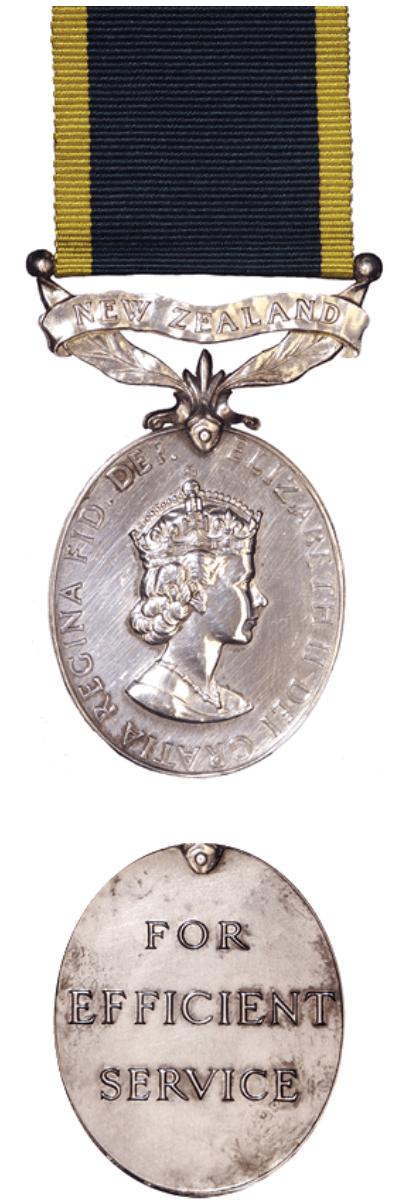
The Efficiency Medal and clasps are rewards for long and meritorious service by warrant officers, non-commissioned officers, and soldiers of the New Zealand Territorial Force who have performed the requisite qualifying service under these regulations.

1937

  • E.T Prichard (18-Year Clasp)
  • 31289 R.H Miller (24-Year Clasp)
  • 34927 R.B Mendoerwcroft (18-Year Clasp)

1942

  • A Paton (24-Year Clasp)

1946

  • 31690 J.H Bell (18-Year Clasp)

1954

  • 30224 F.A Bishop

1955

  • 31365 J.A.G Bremner
  • 35454 E.C Pedersen
  • 31246 D.K Wilson

1956

  • 37462 D.H Driver

1969

  • 717032 L.A Cairns-Cowan (24-Year Clasp)

1973

  • 209062 I.M Stevenson

1977

  • J839140 R.J.R Peterson (18-Year Clasp)

1978

  • 4 76998 R.D Cryer

1981

  • G728945 G.N Young

1982

  • F484385 R.C Kiddie

1985

  • W853550 P.V Collins
  • G755280 J.R Ealker

1986

  • V44294 B.A Goldstone
  • G76566 P.W Finnerly

1987

  • F744929 C.C Olsen

1988

  • X7 59734 B.R Neal
  • E755278 B.G Gooch

1989

  • G20933 B Bremner
  • R42335 G.L McGhie
  • K478041 W Pautapa

1990

  • 841470 B.R Swain
  • K632808 R.J.R Webb
  • J768576 C.W Cormack, 1 Bde Wksp

1993

  • W75890 M.J Emery, 1 Log Regt
  • V75096 K.L Monk, 1 Log Regt
  • U748162 G.J West, 1 Log Regt

Mentioned in Dispatches (MID)

A Mentioned in Dispatches award was awarded when a serviceman’s name appeared in an official report written by a superior officer and sent to the high command, in which his or her gallant or meritorious service was described.

1916

  • Captain William Thomas Beck

1917

  • Lieutenant Colonel Alfred Henry Herbert

1918

  • Staff Quartermaster-Sergeant Reginald Pike

1919

  • Armourer-Sergeant Charles Mervyn Abel

For distinguished and gallant services and devotion to duty during the period 16th September 1918 to 15th March 1919

  • Captain Charles Ingram Gossage

For distinguished and gallant services and devotion to duty during the period 16th September 1918 to 15th March 1919

  • Corporal Matthew Henderson

For distinguished and gallant services and devotion to duty during the period 16th September 1918 to 15th March 1919.

  • Warrant Officer First Class (Conductor) Clarence Adrian Seay

1941

  • Staff Sergeant Stanley Copley Bracken
  • Private John Wilson Wallace

1942

  • Second Lieutenant Thomas Lindsay Cooper
  • Captain Donald Edward Harper
  • Lieutenant Colonel John Owen Kelsey

1944

  • Captain John Brodie Andrews
  • Captain Gordon Stanley Brash
  • Staff Sergeant Allen Anthony McMahon
  • Lance Corporal Colin James Ross
  • Staff Sergeant John Bell Taylor
  • Warrant Officer Class One Robert William Watson

1945

  • Staff Sergeant Francis William Thomas Barnes
  • Honorary Major Conrad William Owen Brain
  • Staff Sergeant Henry France
  • Corporal Lewis James Garnham
  • Corporal Robert Love Gibbs
  • Lieutenant Colonel Donald Edward Harper
  • Captain Robert Clay Jones
  • Lieutenant Colonel John Owen Kelsey
  • Warrant Officer Class Two Thomas Edward Lawson
  • Corporal Charles Hector Lorrett
  • Private William McCullough
  • Warrant Officer Class Two Alexander Douglas McKenzie
  • Captain Harrison Lee McLaren
  • Warrant Officer Class Two Robert Morrison
  • Sergeant Arthur William Thomas Pearce
  • Staff Sergeant Lionel Pedersen
  • Corporal Stanley Hewitson Phillips
  • Warrant Officer Class Two James Pilgrim
  • Staff Sergeant John Frederick Popenhagen
  • Warrant Officer Class Two James Roughan
  • Private John Edwin Sanders
  • Corporal Gilbert Scarrott
  • Warrant Officer Class One Julius John Charles Schultz
  • Private Charles Edward Sumner
  • Corporal Thomas Henry Sunley
  • Sergeant Peter Llewellyn Wagstaff

1946

  • Corporal Harding George Bommer
  • Warrant Officer Class Two Thomas Clifford Catchpole
  • Sergeant John Earnest Donoghue
  • Private Vernon Charles Goodwin
  • Lance Corporal Herbert Ernest Edwin Green
  • Sergeant Leslie Louis Merlin Hallas
  • Major Hugh France Hamilton
  • Private Charles Wesley Helliwell
  • Corporal Douglas Haig Spence Hunter
  • Lance Corporal Arthur Leask
  • Corporal William Hugh McIntyre
  • Lance Corporal Jack Clifford Miller
  • Captain Harold Oakley Nuttall
  • Private Albert Nuttridge
  • Private Edwin Albert Oberg
  • Captain Ronald Stroud
  • Captain Edwin Charles Sutcliffe
  • Second Lieutenant Ian Talbot
  • Driver Maurice Joseph Trewarn
  • Private Charles Sutcliffe West
  • Corporal Robert Yates

1947

  • Corporal Jack Stanley Wooster (Recommended)
    Wooster

1968

  • Captain and Quartermaster (temporary) David
    Ralph Hughes

Legion of Merit

Us_legion_of_merit_legionnaire
Legion of merit. Wikipedia Commons

The Legion of Merit is a United States military award that is given for exceptionally meritorious conduct in the performance of outstanding services and achievements. The decoration is issued to members of the United States and foreign militaries.

1947

  • Lieutenant-Colonel Maurice Salmon Myers.

Colonel Myers has been head of the Ordnance Service of this division since its arrival in the South Pacific area in November 1942. Throughout his employment in this capacity he has rendered signal service to the division, notably in regard to the procurement of equipment which has been supplied to us through American sources. Without his careful foresight and planning the equipment problems of the Third New Zealand Division would have been much greater than they proved to be.

Armed Forces Honour Medal 2nd Class

v24b-south-vietnam-honor-medal-armed-forces-2nd-class-medal-in-country-made-1b54ed53275ff4e36e2d84247b626beb
South Vietnam Honour Medal 2nd class

The Armed Forces Honour Medal was a South Vietnamese medal awarded to any member of the military who actively contributed to the formation and organisation of the Vietnamese military in South Vietnam. The medal was intended for non-combat achievements. The second class medals were awarded to warrant officers and enlisted personnel.

  • Staff Sergeant  G.W. Byrom
  • Sergeant B.R. Swain

Sources

Beattie, P., & Pomeroy, M. (2016). Gallant acts & noble deeds: New Zealand Army honours and awards for the second World War. Auckland: Fair Dinkum Publications.

Chamberlain, H. (1995). Service Lives Remembered: The Meritorious Service Medal in New Zealand and Its Recipients, 1895-1994. H. Chamberlain.

McDonald, W. (2001). Honours and Awards to the New Zealand Expeditionary Force in the Great War, 1914-1918. Hamilton, New Zealand: Richard Stowers.

Polaschek, A. (1983) The complete New Zealand Distinguished Conduct Medal. Christchurch, Medals Research Christchurch.

http://www.vietnamwar.govt.nz/help, (Ministry for Culture and Heritage),

Copyright © Robert McKie 2017


Ordnance during the Field Force era 1964 – 1978

To meet SEATO commitments, the New Zealand Army was reorganised in 1964, with an Infantry Battalion based in Malaysia as part of the British Commonwealth Strategic Reserve. The remainder of the Army was organised to reinforce the overseas elements at short notice and, with a more extended notice period, forces able to meet other commitments outside of the scope of the Strategic Reserve. To achieve this the Army was organised as:

  • Field Force
    • The Combat Brigade Group – Organised as a combat force for commitments outside of the scope of the Strategic Reserve.
    • The Logistic Support Group – Organised to provide support in the field to the Combat Brigade Group.
    • The Combat Reserve Brigade Group – Designed to backfill personnel from the Combat Brigade Group and Logistic Support Group on their mobilisation, to provide trained reinforcements.
  • Static Support Force – all the static non-deployable units.

RNZAOC Locations and Roles

The RNZAOC maintained units on a regional basis.

  • Combat Brigade Group units based in the Northern region,
  • Logistic Support Group units based in the Central region,
  • Combat Reserve Brigade Group units based in the Southern region, and
  • Static Support Force units base throughout the country in non-operational support roles.

Units classed as Operating units had a real-time peacetime support role, all others only had training roles.

Up to 1968 Ordnance units, their locations and dependencies are detailed in the following three tables.

Ordnance In the Northern Military District

1968 NMD

1st COD 1971

1st Central Ordnance Depot – 25 June 1971. RNZAOC School

Ordnance In the Central Military District

1968 CMD

CDOD 1965

Central Districts Ordnance Depot 1965. Dave Morris Collection


Ordnance In the Southern Military District

1968 SMD

Dress Embellishments

Circular Coloured patches 1½ inch in diameter were worn on the shoulder Battledress and then Service Dress just below the Corps Shoulder Title, these patches were discontinued in the mid-1970’s.

  • Combat Brigade Group – Black
  • Logistic Support Group – Red
  • Combat Reserve Brigade group – Green
  • Static Support Force – Blue

1968 Reorganisation

In 1968 it was decided to refine the RNZAOC organisation to better suit its outputs, resulting in name changes, roles changes, relocation and disestablishment for some units.

Unit Name Changes

  • The Main Ordnance Depot at Trentham was renamed 1 Base Ordnance Depot.
  • The three District Ordnance Depots were renamed as Central Ordnance Depots
    • Northern District Ordnance Depot – 1 Central Ordnance Depot
    • Central District Ordnance Depot – 2 Central Ordnance Depot
    • Southern District Ordnance Depot – 3 Central Ordnance Depot

Note: It was mooted that ‘Command’ instead of ‘Central’ be used as the name of the Ordnance Depots, and some correspondence does refer to the COD as Command Ordnance Depots.

Roles Changes and Re-locations

  • 1 Infantry Brigade Group Ordnance Field Park based at Trentham and already partly scaled but with no role other than training this was moved to Ngaruawahia, with the task of maintaining the Equipment Tables of Combat Brigade group units.
  • 1COC PLAQUE

    1 Composite Ordnance Company Plaque. Peter Cox collection


    1 Composite Ordnance Company assumed the role as the significant bulk Ordnance stock-holding unit in the Field Force, with responsibility for issuing bulk to 1 Ordnance Field Park and all Workshop Stores Sections and detailed Issues to all Logistic Support Group units. This unit had a peacetime holding of 60 -90 days of War Reserve stocks which were transferred from 1 Base Ordnance Depot. All Platoons were centralised at Mangaroa, less 4 (Ammo) Platoon, located at Makomako and loaned back to 2 Central Ordnance Depot.

  • 3 Infantry Brigade Group Ordnance Field Park situated at Ngaruawahia with no stocks held and performing only a Training Role, this unit was relocated to Burnham where the majority of Combat Reserve Brigade Units were located, continuing to have no stock-holding responsibility and only have a training role.

There was no change to the Role and locations of the Workshops Stores section and RNZAOC school.

GEN OUTLINE.jpg

Disestablishment

The Small Arms and Proof Office co-located at Mount Eden with the Colonial Ammunition Company was closed down, and the Army ended its long relationship with the Colonial Ammunition Company when that company closed down.

The Ammunition Proof and Experimental Centre operations were also closed down, and its operations moved to the new Joint Services Proof Establishment, a Tri-service unit established as part of the Naval Ammunition Depot ad Kauri Point in Auckland.

RNZAOC Overseas

Throughout the 1960s the RNZAOC provided individuals for overseas service, with the bulk serving with the Australians in South Vietnam and 1 RNZIR at Ternadak Barracks in Malaysia.

In 1970 due to a proposed British withdrawal from Singapore, the RNZAOC made a commitment with the RAAOC to form 5 Advanced Ordnance Depot in Singapore. 5 Advanced Ordnance Depot was the first RNZAOC unit overseas since Kayforce during the Korean War, and the RNZAOC retained a unit in Singapore until 1989.

Future Reorganisations

The RNZAOC retained this organisation until the late 1970s, when the Rations and Fuel functions were gained on the disestablishment of the Royal New Zealand Army Service Corps, and the RNZAOC underwent another Reorganisation, which will be covered in another article.

Copyright © Robert McKie 2017


British Commonwealth Ordnance Corps Badges 1895 – 2019

Ordnance badges in the United Kingdom and many present and former Commonwealth countries indeed have their origins in the Coat of Arms of the Board of Ordnance. The Board of Ordnance was a British government department responsible for the supply and maintenance of the army’s ordnance and equipment. Its coat of arms and insignia were adopted for use on various military badges and insignia. Here’s some additional information about this history:

Coat of Arms of the Board of Ordnance: The Board of Ordnance adopted its coat of arms, which featured various elements symbolizing its role in supplying and managing ordnance, in the 17th century.

  • Royal Approval: While the badge came into use in the 17th century, it wasn’t officially granted royal approval until 1806. This royal approval signified official recognition and authorization for the use of the coat of arms on military items and badges.
  • Confirmation by the College of Arms: In 1823, the Arms of the Board of Ordnance were confirmed by a grant from the College of Arms. The College of Arms is the official body responsible for regulating and granting coats of arms in England, and its confirmation further solidified the legitimacy of the badge.
  • Commonwealth Adoption: As the British Empire expanded and evolved, the badge of the Board of Ordnance was often adopted by Commonwealth countries that were part of the empire. These countries included Canada, Australia, New Zealand, and various African and Caribbean nations. The use of this badge by Commonwealth forces helped maintain a sense of continuity and tradition within the military.
  • Legacy: While the Board of Ordnance itself was disbanded in the 19th century, its coat of arms and insignia continue to be part of the military heritage of the United Kingdom and many Commonwealth countries. These badges are often seen on military uniforms, especially on items related to logistics, supply, and ordnance.

The adoption of the Board of Ordnance’s coat of arms and insignia into the military traditions of the United Kingdom and the Commonwealth countries reflects the historical significance of this organisation in supplying and equipping armed forces. It also underscores the continuity and historical ties among these nations within the Commonwealth.

The insignia of the Board of Ordnance comprises the following elements:

Board of Ordnance details

Shield

  • Background: The shield features a blue background.
  • Field Pieces: Three gold field pieces (cannons or artillery pieces) are displayed on the blue background.
  • Cannonballs: In the top portion of the shield, there are three silver/white cannonballs, likely representing ammunition or firepower.

Crest

  • Silver/White Crown: Rising from a silver/white crown is a right arm.
  • Grasping a Thunderbolt: The right arm is grasping a thunderbolt.
  • Wings Against a Flaming Background: The design includes wings against a flaming background. This imagery could symbolize the power, speed, and force associated with the work of the Board of Ordnance.

Supporters

  • Cyclops Figures: The supporters are two cyclops figures, each with a specific tool. Certain accounts describe the cyclops figures as England’s legendary guardians, Gog and Magog, who are believed to awaken in times of national peril. Additionally, there is historical reference to the use of the names Gog and Magog for the barges used to transport sizable cannons up the River Thames for testing purposes.
  • Right-hand Cyclops: The right-hand cyclops is holding a hammer, symbolizing craftsmanship or construction.
  • Left-hand Cyclops: The left-hand cyclops is holding a pair of forceps, possibly representing precision or delicate work.
  • Resting on the Shoulder: Each cyclops rests their respective tools on their shoulder, emphasizing their readiness to carry out their tasks.

Motto

  • In the Riband: The motto is written in a riband, a narrow band or scroll.
  • Motto Translation: The Latin motto “sua tela tonanti” is loosely translated as “To the warrior his arms.” This motto underscores the organization’s commitment to providing arms and equipment to support military efforts.


The standard component of the Coat of Arms featured on Ordnance cap badges consists of a shield adorned with three cannons and three cannonballs. Variations of these badges may include a riband below the shield, bearing either the Corps motto or a descriptor of the corps to which the insignia belongs.

In the early versions of Australian and New Zealand Ordnance badges, an annulus encircled the shield, inside of which was inscribed the name of the respective Corps.

Internationally, many Ordnance badges have included national identifiers placed above the shield. For instance, Canada featured a beaver on their 1903 badge, and New Zealand used the letters “NZ” on various versions of their badge.

A consistent characteristic of these badges is that the cannons are always directed to the right (known as “Dexter” in heraldic terms). However, there are exceptions, such as the New Zealand Army Ordnance Corps (1917-23) and South Africa Ordnance Corps (1923-33) badges, where the cannons face to the left (known as “Sinister” in heraldic terms).

Upon receiving Royal status, most badges received two additional features. First, permission was granted to display the Royal garter in a buckled circle or oval, bearing the motto “Honi Soit Qui Mal Y Pense.” Translated from Old French, this motto means “Shame be to him who thinks evil of it.” It can also be interpreted as “Evil (or shame) be to him that evil thinks” or “shame on anyone who thinks ill of it.”

Second, the badges incorporated crowns to signify the reigning monarchs:

  • From 1918 to 1953, the Tudor or “Kings Crown” was used on badges.
  • Starting in 1953, the St. Edward’s or “Queens crown” became the standard for these insignias.

These details contribute to the rich history and symbolism of Ordnance badges, reflecting changes in royal representation and the unique attributes of each corps.

Listed below are examples of some of the various ordnance badges of the United Kingdom, Australia, Canada, India and South Africa. Examples of New Zealand pages can be found at Ordnance Badges of New Zealand 1916-1996.


Great Britain

Beginning in 1896, the United Kingdom maintained two distinct Ordnance entities:

  • The Army Ordnance Department, which consisted of officers.
  • The Army Ordnance Corps, which comprised other ranks.

In July 1896, following a recommendation from the War Office, Queen Victoria granted approval for the incorporation of the arms of the Board of Ordnance into the badge of both the Army Ordnance Department and the Army Ordnance Corps (AOC). This incorporation involved using the shield from the Board of Ordnance arms, excluding the crest and the supporters, as a central element in the badge design.

These two cap badges were crafted in a similar design, differing primarily in the wording displayed on the scroll beneath the shield. These badges served as the predecessors to all Imperial and subsequently Commonwealth Ordnance Corps badges. Elements of their design were later adopted by various Commonwealth Ordnance Corps throughout their histories.

The Army Ordnance Department and Corps were combined in 1918 to form the ‘Royal Army Ordnance Corps,’ remaining in existence until 1993 when it was disestablished to form the ‘Royal Logistic Corps‘.

Australia

The Australian Army Ordnance Stores Corps was established on July 1, 1902, concurrently with the civilian-administered Australian Army Ordnance Department, which operated under Civil Service management.

In a significant transition in 1942, the corps was brought entirely under military jurisdiction and rebranded as the Australian Army Ordnance Corps. This transformation marked a turning point in its history, and in 1948, it was honored with Royal status.

The badge design, featuring a King’s crown, received official approval in 1948. Initially, this design was exclusively worn as a collar badge. However, in 1956, a cap badge bearing a Queen’s Crown was introduced, which has continued to be in use to this day.

As King Charles ascends to the throne, it is likely that the crown on the badge will be updated to reflect his heraldry, possibly reverting to the Tudor Crown.


Canada


Established in 1903 under the name ‘Ordnance Stores Corps,’ this organisation underwent several transformations in its history. In 1907, it was rebranded as the ‘Canadian Ordnance Corps.’ In a significant development in 1919, it was bestowed with the prestigious Royal designation, becoming the ‘Royal Canadian Ordnance Corps.’

In 1968, with the creation of the ‘Logistic Branch,’ which merged the ‘Royal Canadian Ordnance Corps’ and the ‘Royal Canadian Army Service Corps,’ the Royal Canadian Ordnance Corps was formally disbanded on July 2, 1974.

Malaysia – Royal Ordnance Corps – Kor Ordnans Diraja (KOD)

India

The origins of the Indian Army Ordnance Corps can be traced back to the 15th century when the three Presidencies of the East India Company, namely Bengal, Madras, and Bombay, were formed. The formal recognition of the Indian Army Ordnance Corps took place in 1775 with the establishment of the ‘Board of Ordnance.’

However, in 1855, as part of a global restructuring effort, the Board was disbanded. This led to the creation of the Ordnance State Department and Corps. Subsequently, in 1885, these entities were reorganized into the Army Ordnance Department for officers and the Army Ordnance Corps for soldiers.

In 1922, a significant reorganisation took place, resulting in the amalgamation of the Army Ordnance Department and the Army Ordnance Corps, which were then collectively renamed the Indian Army Ordnance Corps. During this transition, a new corps badge was introduced, closely resembling the previous one but featuring a scroll inscribed with the words “Indian Army Ordnance Corps.”

This badge remained in use until 1954 when the current badge was officially adopted. Interestingly, the IAOC badge should have been discontinued after India became a republic in 1950. However, a delay in finalizing the new crest led to its continued usage until 1954.

Indian Army Ordnance Corps cap, collar badges 1922-1950 and shoulder title. Robert McKie Collection

Following India’s attainment of independence in 1950, the “Indian” prefix was removed from the corps’ name, and it is now simply referred to as the Army Ordnance Corps.

India Army Ordnance Corps- post-1947

Additional Indian Ordnance badges from 1884 to 1922 included:

  • Pagri (Turban) Badge: This badge featured an Ordnance shield surmounted by a fist rising from a coronet while grasping lightning rods. Below this imagery, there was a scroll with the inscription “SUA TELA TONANI.”
  • Waist Belt Clasp: During the King’s Crown period, this clasp displayed the King’s Crown over an Ordnance shield in the center. The word “ORDNANCE” appeared around the top, and “INDIA” was inscribed around the bottom.
  • Pagri (Turban) Badge – WW1 Period: From the World War I era, this badge featured a fist rising from a coronet, grasping lightning rods, and surmounted by two wings. It did not include a scroll.

Pakistan

Upon the partition of India and Pakistan in 1947, Pakistan introduced a modified Ordnance badge based on the Indian Army Ordnance Corps (IAOC) badge. In this adaptation, the crown in the IAOC badge was replaced by the Pakistan ensign, featuring a crescent and a star, and the word “Indian” was substituted with “Pakistan.”

On August 15, 1954, a newly designed badge was officially adopted. Modeled after the Royal Army Ordnance Corps (RAOC) Pattern badge, this badge featured the following elements:

  • The Ordnance shield displaying three cannons and three cannonballs.
  • The Pakistan ensign, which included a five-pointed star.
  • An annulus, or circular band, inscribed with the words ‘Pakistan Army Ordnance Corps.’
  • The Ordnance motto ‘Sua Tela Tonanti,’ translated into English as ‘To the Thunder his Weapons,’ was inscribed onto the riband encircling the badge.

Hyderabad

Hyderabad was a princely state during the British Raj. However, following India’s attainment of independence in 1947, Hyderabad initially maintained its independence. It wasn’t until 1948, when the Indian Army executed Operation Polo, an invasion operation, that Hyderabad was integrated into the Indian union.

Hyderabad Army Ordnance Corps.


Burma

Burma

South Africa


Drawing inspiration from the British model, South Africa established the South African Ordnance Department for officers and the South African Ordnance Corps for enlisted personnel in 1923. These two entities were later merged into a unified corps in 1933. In 1939, further reorganization occurred with the creation of the Technical Services Corps and the ‘Q Services Corps.’

Rhodesia and Nyasaland

During the existence of the Short-lived Federation of Rhodesia and Nyasaland (1953-1963), the Federation’s army maintained the Rhodesia and Nyasaland Army Services Corps, which played a crucial role in providing logistical support to the Federal Army. This corps comprised three distinct branches:

  • Ordnance & Supply Branch: This branch was responsible for the provisioning of all Army arms, supplies, and equipment. It consisted of 150 soldiers.
  • Workshop Branch: Within this branch, artificers and mechanics were tasked with the essential maintenance of vehicles, firearms, and other equipment deployed by the Federal Army. The Workshop Branch had a strength of 270 personnel.
  • Supply & Transport Branch: Comprising one Askari Platoon, two Coloured Afro-Asian Platoons, and one Eurasian Platoon, the Supply & Transport Branch had the critical responsibility of delivering supplies allocated by the Ordnance & Supply Branch to troops in the field. In total, this branch consisted of 180 personnel.

These branches collectively formed the backbone of logistical support for the Federation’s military operations during this period.

Rhodesian and Nyasaland Army Service Corps cap badge 1955-1962. Robert McKie Collection


Bibliography

J.L. Chapple Indian Army Collection catalogue, Part II – Arms and Services, AFI, IST-ISF. (2017). Retrieved from Indian Military History Society: http://durbaronline.co.uk/PDF/PDF6arms-svces.pdf

Copyright © Robert McKie 2017


Zeitoun Ordnance Cap Badge Mystery

British Army Ordnance Corps 1915_zpsaibxjzox

New Zealand Supply Depot Staff at Zeitoun Camp, 1915. National Army Museum of New Zealand

I was recently made aware of this photo of New Zealand Supply Depot Staff at Zeitoun Camp, Egypt, in 1915; it was taken from the album of Major Alexander Charters, CMG, DSO, of the Wellington Infantry Battalion. The picture shows a group of men of the No 1 Depot Unit of Supply (DUS) New Zealand Army Service Corps (NZASC).

ASC

Badges of the NZASC 1910-1947. Robert McKie collection

Based at Zeitoun Camp from August 1915 until 16 March 1916, No 1 DUS was responsible for the supply and distribution of over 28000000 Kilograms of forage, foodstuffs, firewood and other goods to its subordinate units during that time.  It is, on the surface, an unremarkable picture but shows the variety of headwear and uniforms at the time. Most are wearing Wolseley pattern sun helmets, two are wearing Forage Caps, two individuals are wearing felt hats with NZASC Khaki/White/Khaki Puggaree, and one is wearing a Mounted Rifles bandoleer. Most interestingly of all is an individual wearing a Lemon Squeezer hat, with an unidentified Puggaree (most likely an infantry Puggaree) with a British Army Ordnance Corps (AOC) badge.

The question must be asked, why is a New Zealand soldier in 1915 wearing a British Army Ordnance Corps badge?

At the time of the photo, New Zealand did not have an Ordnance Corps, and one was not created in the NZEF until February 1916, (see NZAOC 1916-1919) and at home until 1917. (NZAOC, 1917-1923)   In the context of the NZEF, ad-hoc Ordnance Sections had been established as staff under the New Zealand Division Deputy Assistant Director of Ordnance Services (DADOS). On the arrival of the NZ advance party in 1914, Sergeant (later Major) Norman Joseph Levien had been attached to the British Ordnance Corps Depot at the Citadel in Cairo to study the Ordnance systems in use with the Imperial forces in Egypt to integrate New Zealand into the British Supply System.

f7012f760426cc6df115bf14d6f87977

Rue de la, Porte Rosette, Alexandria, Egypt. Public Domain

Early in 1915, to support the Zealand Forces, Levien, now promoted to Lieutenant, established a New Zealand Ordnance Depot in Alexandra at No. 12 Rue de la, Porte Rosette and a warehouse at Shed 43, Alexandra Docks.

Given the need to outfit New Zealand units as they arrived in Egypt and as the New Zealand Forces returned from Gallipoli, there was a significant effort to refit, refurbish and re-equip units as they reorganised for future service in France and the Middle East. This put a considerable strain onto the nascent New Zealand Ordnance Corps, requiring, in addition to the original DADOS staff, the drafting in of additional soldiers with clerical, stores and maintenance experience from within NZEF. Records analysed so far identify 13 Other Ranks (Private to Company Sergeant Major), who joined the NZAOC on its formal creation in Feb/Mar 1916, some of whom had been working in Ordnance roles since 1914.

British Army Ordnance Corps_zpshkmjkhxu

Ordnance Member, New Zealand Supply Depot Staff at Zeitoun Camp, and was definitely taken in 1915. National Army Museum of New Zealand

Unlike the soldiers of the NZASC who deployed as part of the established NZASC organisation and wore the NZASC cap badge.  Soldiers posted to NZ Ordnance deployed from NZ on the strength of the unit or Battalion that they had enlisted into and were posted to the Ordnance establishment after their arrival in Egypt and retained the cap badge of their parent unit. This might have caused some confusion and based on the evidence of the Zeitoun photo, at least one Ordnance soldier utilised a British AOC badge to identify himself as Ordnance.

RAOC 1918

UK Army Ordnance Corps Badge 1895-1918. Robert McKie Collection

Judging by the puggaree on this soldier’s lemon squeezer hat, this soldier has transferred to Ordnance from one of the New Zealand Infantry Battalions and quite possibly retains his parent unit’s collar badges. Unfortunately, the quality of the picture doesn’t provide enough detail to identify the group with any certainty.

This picture raises several questions.

  • Was this an officially endorsed dress embellishment to identify individuals employed in Ordnance roles, possibly with the endorsement of the British Ordnance establishment in Egypt?
  • Was it just a case of an individual employed in an Ordnance role using the renowned Kiwi initiative and acquiring an AOC badge to show that he was Ordnance?
  • Was it just an ASC soldier displaying an AOC badge he had just swapped as a keepsake? (A thriving trade caused a shortage of badges)
  • Was it, in fact, a British Ordnance Soldier wearing an acquired lemon Squeezer?
  • In 1914 there were several British Army Ordnance Corps Armourers posted to Alexandra barracks at Mount Cook in Wellington. Are they part of this mystery? Did some of these Armourers deploy with the NZEF to the Middle East?
  • Does the use of its badge have its origins back in 1913 when the first Ordnance Depots were established for the New Zealand Territorial Amy annual camps, and this individual was one of the original members?

Until further photographic evidence or written documentation is discovered, this picture raises more questions than answers, but this photo does provide a starting point for later research to unravel this cap badge mystery.  I have seen some examples of this badge with the letters “NZ” affixed on top of the shield. Are these modified badges part of the same story?

Eventually, the NZAOC in the NZEF adopted its own badge either in 1916/1917 and on the creation of the Home Service NZAOC in 1917, the adoption of its own badge. The use of both badges evolved several times into the 1955 pattern that served the RNZAOC until 1996.

Copyright © Robert McKie 2017

british-army-ordnance-corps-1915_zpsaibxjzoxC

New Zealand Supply Depot Staff at Zeitoun Camp, 1915 (Colourised). National Army Museum of New Zealand


New Zealand Army Ordnance Corps buttons

Military buttons are as varied as cap badges. It was common for individual Regiments or Corps to have their own unique regimental button. The New Zealand Army Ordnance Corps was no exception, with buttons featuring the Ordnance Crest between 1917 and 1996.

Button Background

Uniform Button Sizes & Types

Military buttons, specifically those used by the United Kingdom, New Zealand and other Commonwealth nations, fall into 3 size categories:

  • Small – about 14mm diameter and used for caps, mess dress waistcoats (vests) and gorgets (red or blue tabs worn by Staff Officers on the collar).
  • Medium – about 19mm diameter and used on pockets and shoulder straps (epaulettes) of most parade uniforms and service dress.
  • Large – about 25mm diameter and used on great-coats and Service Dress jackets.

Button Ligne – the traditional way of measuring buttons

As with many military items, buttons have their own measurement system, which is known as ‘Lines’ or ‘Lignes’, where the diameter of buttons is measured, and the measurement in Lignes equates to 40L = 1 inch = 25.4 millimetres. The common Lignes are;

  • 14L – 9mm
  • 16L – 10.5mm
  • 18L – 11.5mm
  • 20L – 12.5mm
  • 22L – 14mm
  • 24L – 15mm
  • 26L – 17mm
  • 28L – 18mm
  • 30L – 19mm
  • 32L – 20.5mm
  • 36L – 23mm
  • 40L – 25.5mm
  • 44L – 28mm
  • 48L – 30mm

New Zealand Ordnance Buttons

Seven different types of Buttons used by the New Zealand Ordnance Corps from 1917 have been identified

  • Brass 1911 New Zealand Forces button
  • Brass New Zealand Army Ordnance Department, 1917-1924,
  • Brass New Zealand Army Ordnance Corps circa 1917-1924,
  • Brass New Zealand Ordnance Corps, 1924-47,
  • Brass New Zealand Army Ordnance pre-1953,
  • Gilt Royal New Zealand Army Ordnance Corps, 1947-1955,
  • Anodised Royal New Zealand Army Ordnance Corps, 1955- 1996.

The dates listed were not the actual dates when the buttons were in service but the period that the particular iteration of the Ordnance Corps was in existence. It could be assumed that some buttons remained in service after newer versions were introduced.

1911 New Zealand Forces button

The first New Zealand Ordnance Soldiers initially wore the standard New Zealand Forces buttons, which were introduced in 1911. There is ample photographic evidence depicting these buttons being worn by both the NZEF NZAOC and the home service NZAOC. However, the use of the 1911 button gradually declined with the introduction of Corps brass buttons, and by 1960, supplies of anodised aluminum buttons for all corps were received from the United Kingdom, leading to the fading of the 1911 button from widespread use.

The 1911 button resurfaced in widespread use thirty years later in the late 1990s, as all individual corps buttons were phased out and replaced by anodised aluminum versions of the 1911 button.

New Zealand Forces Button 1911. Robert McKie Collection

New Zealand Ordnance Corps (NZOC)

Manufactured by J.R Gaunt & Sons of London, the New Zealand Ordnance Corps buttons are brass and are embossed with an ordnance shield of three cannons, with the standard three cannonballs in the top part of the shield. The shield is mounted with a Kings (Tudor) crown and has the words “New Zealand Ordnance Corps” circling the shield.

New Zealand Ordnance Corps. Robert McKie Collection

It is highly probable that this button, closely resembling the 1901–1918 Army Ordnance Corps (AOC) button worn by officers and warrant officers of the British Army Ordnance Department, belongs to the New Zealand Ordnance Corps (NZOC), established in 1912.

Recognising the need for technical expertise, New Zealand initiated a significant step in 1900 by recruiting two Armourer Sergeants from the British Army Ordnance Corps, with a third joining in 1903. This move marked the foundation of a professionalised Armourer role within New Zealand’s defence framework.

On 1 May 1912, General Order 118 formally established the NZOC, transferring all Armourers from the Defence Stores Department into this newly created corps. The NZOC functioned as an independent entity until 1917, when it was absorbed into the newly formed New Zealand Army Ordnance Corps.

New Zealand Army Ordnance Department (NZAOD)

Gazetted by regulations published on 1 February 1917, the New Zealand Army Ordnance Department (NZAOD) was established as part of the permanent staff of the Defence Forces of New Zealand and consisted only of Officers.

Manufactured by Hobson & Sons of London and Extra Super, NZAOD buttons are brass, embossed with an ordnance shield of three cannons. Instead of the standard three cannonballs, there are two stars in their place with the letters NZ in between. The shield is mounted with a Kings (Tudor) crown and has the words “Army Ordnance Department” circling the shield.

The NZAOD was combined with the New Zealand Army Ordnance Corps in 1923. Given that the larger Ligne sizes are relatively common, they probably remained in use for several years after 1923.

New Zealand Army Ordnance Department, 1917-1924. Robert McKie Collection

Royal New Zealand Army Ordnance Corps 1948-1953

Manufactured by J.R Gaunt & Sons of London, the Royal New Zealand Ordnance Corps buttons are brass and embossed with a badge similar to the 1947-55 RNZAOC badge with a Kings (Tudor) crown and NZ between the Garter and Riband. The standard wording “Honi Soit Oui Mal Y Pense” is not included in the Garter, but a series of large and small dots have been included where the usual script was normally placed.

Brass Royal New Zealand Army Ordnance Corps 1948-1955. Robert McKie collection

Royal New Zealand Army Ordnance Corps, Gilt Mess Buttons

On the 6th of May 1948, an order was placed in the United Kingdom for six hundred anodised aluminium buttons of the pattern illustrated in the following picture.

Anodised Royal New Zealand Army Ordnance Corps buttons

Anodised aluminium buttons for all New Zealand Army Corps and Regiments were first introduced into service in May 1960. Manufactured by various companies, including Gaunt and Firmin, these buttons remained in use until the disbandment of the RNZAOC in 1996. The buttons feature the badge of the RNZAOC, with the St. Edward’s Crown embossed onto them.

Royal New Zealand Army Ordnance Corps, 1955-1996. Robert McKie Collection

British Ordnance Buttons

The following British Ordnance buttons are familiar in New Zealand and, as with Ordnance badges, share many standard design features.

Army Ordnance Department 1901 -1918

Army Ordnance Department 1896 – 1901 Robert McKie Collection

Royal Army Ordnance Corps 1918 – 1949

Royal Army Ordnance Corps 1918 – 1949 Robert McKie Collection

Manufacturers Marks

Located on the rear of the button, manufacturer marks identify the various button manufacturers that produced buttons for the NZ Army over the last one hundred years, of which some examples are shown below.

Copyright © Robert McKie 2017


From the First World War to the Corps’ amalgamation into the RNZALR in 1996, Ordnance soldiers wore a small family of badges that evolved with the organisation. Despite variations in metal finish and detail, the core design language stayed remarkably consistent: crown, garter, the “Ordnance shield” of three guns and three round-shot, the Corps motto on a riband, and “NZ” to mark national service.

This page summarises the main patterns and clears up a few persistent misconceptions..

The Crown

  • 1937 – 1955 – the Kings (Tudor) crown
  • 1955 – 1996 – the Queens (St Edwards) Crown

Annulus

  • 1937-47 pattern badge – annulus inscribed with the words “New Zealand Army Ordnance Corps
  • 1948 -96 pater badges – annulus was the royal Garter inscribed with the motto of the British Order of the Garter ‘Honi soit qui mal y pense’

Riband

The Riband has had Many variations since 1916. Inscriptions have included.

  • Ordnance
  • Army Ordnance Dept
  • Army Ordnance Corps
  • Sua Tela Tonanti

Shield

The most recognisable feature on all Ordnance badges is the Ordnance shield of three cannons and three cannonballs.

Collar badges

Collar badges were either a variation or copy of the cap badge, coming in pairs with the cannons facing inwards.

Evolution of the Ordnance badgeTHE BADGES

Pre-war

Before the First World War, the New Zealand Military Forces had no dedicated ordnance organisation. Responsibilities were split between two bodies: the Defence Stores Department, which handled the supply and maintenance of clothing, accoutrements, small arms, machine-guns, and associated ammunition; and the Royal New Zealand Artillery, which managed the storage and maintenance of artillery equipment and ammunition.

The need for a New Zealand ordnance organisation was recognised as early as 1900. While Canada and Australia moved to establish an indigenous ordnance corps on the British model, New Zealand proceeded more cautiously.

From 1900, three armourers of the British Army Ordnance Corps (AOC) were seconded to the New Zealand Defence Stores. By 1912, they had trained enough local armourers that a formal trade and career pathway, from apprentice to senior armourer, was required. To provide this structure, the New Zealand Ordnance Corps (NZOC) was established on 1 May 1912. While seconded, the AOC armourers were expected to wear a New Zealand uniform and embellishments; however, with the NZOC’s establishment, it is possible that, as members of a specialist corps, the British NCOs reverted to wearing their AOC badges.

Badge of the Army Ordnance Corps 1895-1918. Robert McKie Collection

General ordnance services began to take shape at the 1913 annual camps, where temporary Ordnance Store Depots were piloted as a proof of concept. The experiment created the nucleus of an ordnance corps, with selected Territorial Force personnel trained in ordnance duties.

Under this temporary scheme, a small ordnance cadre operated at each annual camp from 1913 under the Director of Equipment and Stores. It remains unclear whether these depot personnel wore any distinctive insignia.

First World War 1914-1921

As mobilisation began, Ordnance Depots were raised and staffed by personnel who had received ordnance training at earlier annual camps. One example is Temporary Sergeant Norman Levien, who transferred from the 3rd Auckland Regiment to the Ordnance Department as In charge of Stores and Equipment, playing a key role in equipping troops for overseas service.

Levien later enlisted in the NZEF and became a founding member of the New Zealand Army Ordnance Corps (NZAOC) when it was formed within the NZEF in March 1915. He remained with the Corps throughout the war, rising to Major and serving as Chief Ordnance Officer for the NZEF in the United Kingdom.

Royal New Zealand Artillery Ordnance Corps Section

To offset distance from traditional supply sources and wartime constraints, an Ordnance Corps Section for inspecting and manufacturing artillery ammunition was established on 1 April 1915 at Fort Balance, Wellington. As part of the Royal New Zealand Artillery, its personnel wore the RNZA badge.

NZEF New Zealand Army Ordnance Corps 1916-1919.

The NZAOC began as an ad hoc arrangement during NZEF mobilisation in 1914 and was formally constituted in March 1915, with Sergeants T. J. King and N. J. Levien commissioned as Second Lieutenants. The exact date the Corps adopted its own insignia is unknown; photographic evidence from Zeitoun Camp (1915) shows a New Zealand ordnance soldier wearing British AOC badges, likely used for identification until New Zealand patterns were issued.

New Zealand Supply Depot Staff at Zeitoun Camp, 1915. National Army Museum of New Zealand

There is no reliable photographic or documentary evidence that New Zealand ordnance soldiers modified British AOC badges by adding “NZ”. Such field-made alterations may have been tried, but they were never authorised and, if they occurred at all, were short-lived.

1895-18 AOC modified into an NZAOC Badge. Robert McKie Collection

An official NZAOC cap badge—derived from the British Army Ordnance Department device—was introduced for the NZEF and became the recognised insignia of the Corps, superseding any unofficial experiments..

Official NZEF NZAOC Badge

The official NZEF NZAOC badge was derived from the British AOD device, with the letters “NZ” superimposed on the shield. The exact pathway to its introduction is not documented.

In late 1916, Norman Levien was promoted to Captain and appointed Chief Ordnance Officer for the NZEF in the United Kingdom. Through liaison with other Commonwealth ordnance services—particularly the Canadian Ordnance Corps (COC)—he may have been influenced by their approach to national distinction. The COC, authorised in 1903, used an AOD-based badge with a beaver as its crest, signalling a national identity atop the common ordnance motif.

Canadian Ordnance Corps badge, 1903-1922. Robert McKie collection

.

Army Ordnance Department. 1895-1918. Robert McKie Collection

J. R. Gaunt, London, manufactured the NZEF NZAOC cap badge. It was die-struck, with the “NZ” separately made and then soldered (“sweated on”). This suggests two possibilities: either surplus British AOD badges were reworked by adding the NZ cypher, or new badges were produced from purpose-made dies for the NZEF. The precise method is not documented.

Matching collar badges were produced as miniature versions of the cap badge. Issued as facing pairs, they had the guns pointing inwards.

The badge was likely introduced in late 1916 and remained in use until NZEF demobilisation in 1919. Some personnel on residual duties in the United Kingdom continued to wear it until 1921. Surplus stocks were repatriated to New Zealand as part of the NZEF wind-down.

New Zealand Army Ordnance Corps Badge, 1916-1919 (Robert McKie Collection 2017)
20171005_164430
Major Gossage, DADOS HQ NZ Division Leverkusen, Germany Feb 1919.

Variations of the NZEF NZAOC Badge

Documented examples show the NZEF NZAOC cap badge—with matching, facing collar badges—produced in both brass and bronze.

Some former NZEF ordnance personnel continued to wear the NZEF pattern in the inter-war years. A 1934 photograph shows Armament Staff Sergeant Arthur Stewart Richardson wearing the NZEF-pattern cap badge, while Armament Staff Sergeant John William (“Bill”) Dalton wears the 1917 pattern.

Waipukurau 1934a
Armament Staff Sergeant John William(Bill) Dalton and Armament Staff Sergeant Arthur Stewart Richardson, Artillery camp, Waipukurau March 1934. Photo courtesy Norm Lamont

New Zealand Army Ordnance Department and New Zealand Army Ordnance Corps 1917-1923

On 1 February 1917, the New Zealand Army Ordnance Department (NZAOD) was established for commissioned ordnance officers, alongside the New Zealand Army Ordnance Corps (NZAOC) for warrant officers, NCOs, and other ranks. Together they were responsible for the supply, maintenance, and repair of equipment, small arms, and ordnance stores for the Defence Force.

At formation, the NZAOD/NZAOC drew personnel from the Defence Stores Department, NZOC armourers, and gunners from the RNZA Ordnance Corps Section.

New Zealand Army Ordnance Department Badge 1917-1924

Derived from the British Army Ordnance Department (AOD) device, the New Zealand version introduced two clear changes: the central round shot in the top panel of the shield was replaced by the letters “NZ”, and the scroll beneath the shield was inscribed “Army Ordnance Department.”

New Zealand Army Ordnance Department badge 1917-1924. Robert McKie collection

New Zealand Army Ordnance Corps Badge 1917-1937

Inspired by the British AOC device, the New Zealand version introduced clear national distinctions: the centre round shot in the top panel of the shield was replaced by “NZ”, and the scroll beneath the shield read “Army Ordnance Corps.”

The 1917 pattern is unusual among ordnance cap badges in that the guns face in the opposite direction to those on the British AOC pattern.

The collar badge, shared by both the NZAOD and NZAOC, was a simplified shield: inward-facing guns, the centre round shot replaced by “NZ”, and no scroll.

In 1924, the NZAOD was reorganised into the NZAOC; the NZAOC cap badge continued in service as the Corps badge until 1937.

New Zealand Army Ordnance Corps badge 1917-1937. Robert McKie Collection

Variations of the NZAOC 1917-1937 Badge

Examples of the NZAOC 1917-1937 Badge can be found in;

  • Brass, and
  • Bronze


New Zealand Army Ordnance Corps 1937-1947

20170712_142252
20170712_142340

By 1936, stocks of the 1917-pattern cap badge had been exhausted, leaving only collar badges. The Director of Ordnance Services (DOS) proposed to the Quartermaster-General (QMG) that existing NZEF NZAOC stocks—180 cap badges and 319 pairs of collar- were to be replaced.

In February 1937, the DOS initiated a competition within the NZAOC to select a new design. Sergeant C. Bryant’s entry won, drawing on the contemporary style of the Royal Army Ordnance Corps (RAOC).

The New Zealand badge followed the RAOC pattern but with national distinctions: the annulus carried “New Zealand Army Ordnance Corps”, and the riband bore “Sua Tela Tonanti”. The design received formal approval on 31 May 1937.

Variations of the NZAOC 1937-1947 Badge

Documented examples of the 1937–1947 NZAOC cap badge—usually with matching, facing collar badges—exist in the following finishes:

  • Brass
  • Bronze
  • Plastic (wartime economy issue)
  • Gilt silver and enamel (officers’ pattern)
20190719_142632
New Zealand Army Ordnance Corps, Officer Gilt, Silver and Enamel Badge. 1937-1947, Robert McKie Collection.
New Zealand Army Ordnance Corps,1937-1947. (This picture illustrates the Brass OR’s Cap badge and Officers Bronze Collar Badge) Robert McKie collection
Plastic New Zealand Army Ordnance Corps,1937-1947. Robert McKie collection

Second World War

Wartime use of the NZEF NZAOC Badge 1939-1947

During the war, earlier NZEF NZAOC badges were recycled for home-service use, primarily by the New Zealand Temporary Staff (NZTS) and within NZAOC units.

New Zealand Temporary Staff 1939-1947

New Zealand Temporary Staff. Robert McKie Collection

From September 1939, the rapid expansion of the home army created acute manpower gaps. The NZTS was raised as a wartime measure to staff new establishments, drawing on older personnel and those medically unfit for overseas service but suitable for home duty—particularly in NZAOC and Motor Transport (MT) Branch units.

Although the official NZTS badge was the Fernleaf, special permission allowed NZTS personnel serving in Ordnance and MT Branch units to wear the earlier NZEF NZAOC cap badge.

The NZTS was disestablished in January 1947 with the creation of the post-war interim army.

New Zealand Ordnance Corps 1940-1947

In December 1940 the New Zealand Ordnance Corps (NZOC) was constituted as an independent corps to provide the ordnance component of the home-service Territorial Force (then often called the Territorial Army). It supported home defence and supplied trained personnel to the Expeditionary Force.

In 1947, a reorganisation removed the distinction between Regular and non-Regular soldiers. The NZOC ceased as a separate corps, with its personnel and functions absorbed into the New Zealand Army Ordnance Corps (NZAOC).

Variations of the NZTS & NZOC 1939-1947 Badge

Examples of the NZTS & NZOC 1939-1947 Badge can be found in

  • Brass
  • Bronze
  • Lead
  • White Metal

Interim Army 1946-48

With the creation of the post-war Interim Army, the Fernleaf cap badge was adopted as its emblem on 11 September 1946. To preserve esprit de corps and continuity with pre-war formations, on 26 September 1946 authorities authorised personnel affiliated with recognised corps—Engineers, Artillery, Ordnance, Electrical and Mechanical Engineers, Army Service Corps, and Signals—to continue wearing their corps or unit badges.

During this period, many NZOC, NZTS, and Motor Transport Branch personnel transferred to the newly formed NZEME but continued to wear the ordnance badge. With only 881 NZOC cap badges remaining in store, a direction issued on 1 October 1946 required all NZOC, NZTS, and MT Branch personnel now serving in NZEME to adopt the Fernleaf badge.


1947
New Zealand Army Ordnance, Christchurch. 1947. Archives New Zealand Te Rua Mahara o te Kāwanatanga, Christchurch R1309080

Royal New Zealand Army Ordnance Corps 1947-1955

On 12 July 1947 the NZAOC was granted Royal status and adopted a new cap badge. The RNZAOC device featured a Tudor Crown above the Garter bearing Honi soit qui mal y pense. Beneath the garter, the letters “NZ” were set above a riband inscribed “Sua Tela Tonanti” (“To the warrior his arms”), signalling the Corps’ elevated standing.

Initial procurements

  • United Kingdom (officers’ pattern): 175 gilt/silver/enamel cap badges; 158 pairs of gilt/silver/enamel collar badges.
  • New Zealand (other ranks’ pattern): 1,600 brass cap badges; 850 pairs of brass collar badges.
Royal New Zealand Army Ordnance Corps 1947-55 badge (Robert McKie Collection 2017)
Royal New Zealand Army Ordnance Corps, Officer Gilt, Silver and Enamel Badge. 1947-1955, Robert McKie Collection.

In 1947, Army Order 36/1947 authorised a 2-inch diamond backing patch to be worn on the Cap, GS or beret behind corps cap badges. For Ordnance, the patch was vertically divided red and blue (example below).

rnzaoc 47-55 diamond
Royal New Zealand Army Ordnance Corps, 47-55 Badge with Ordnance diamond backing patch. Robert McKie collection

Variations of the RNZAOC 1947-1955 Badge

Examples of the RNZAOC 1947-1955 Badge with matching collar badges can be found in.

  • Brass,
  • Gilt Silver and Enamel.

Royal New Zealand Army Ordnance Corps 1955-1996

Following Queen Elizabeth II’s accession on 6 February 1952, a replacement design featuring the St Edward’s Crown was approved in 1955. Due to production delays with the new anodised aluminium cap badges, distribution did not begin until 1962; anodised collar badges became available earlier, from May 1960. Consequently, the 1947–55 Tudor-crown pattern remained in service well into the 1960s.

Anodised Badges

To retain a brass-like appearance, the first post-1955 issue was a plain gilt anodised cap badge. Although approved in 1955, distribution did not begin until 31 May 1962.

In 1964, the Corps moved towards coloured anodised badges. J. R. Gaunt submitted three trial patterns:

  • Sample A — blue applied to the riband background, excluding the garter buckle and the letters “NZ”.
  • Sample B — blue applied to the riband background, excluding the garter buckle.
  • Sample C — blue applied to the riband background, including the garter buckle.

Sample C was accepted and progressively intruded into service from October 1965.

RNZAOC GILT, annodised coloured 1955-1996
Royal New Zealand Army Ordnance Corps GILT, annodised coloured 1955-1996 (Copyright © Robert McKie 2017)

Matching collar badges were provided for both the plain and coloured anodised badges.

Gilt Silver and Enamel

As with the two preceding RNZAOC patterns, an officers’ gilt, silver and enamel version of the 1955–96 cap badge—with matching collar badges—was produced for wear by officers and warrant officers.

Royal New Zealand Army Ordnance Corps, 1955-1996 Gilt, Silver & Enamel Officers Badge. Robert McKie collection

Bullion Woven

RNZAOC Bullion Woven Cap Badge. Robert McKie Collection

The Final Badges

In the early 1990s, the New Zealand Army rationalised cap and collar badges to reduce the cost of maintaining separate officers’ and other ranks’ patterns.

The last RNZAOC cap badge closely followed the officers’ gilt, silver and enamel design, but with a white-metal insert of three round shot mounted above the shield. During production, some inserts were fixed at a slight angle, leading to the batch being quarantined; only a small number were issued before the RNZAOC was disestablished.

The final collar badge was metal with a gilt finish and painted coloured details.

Last Patten RNZAOC Badges. Robert McKie Collection

A note on the “mark of shame” myth

A persistent rumour suggests that adopting RAOC-style devices somehow signified second-rate status. In reality, New Zealand’s use of the shared Ordnance heraldry signalled professional continuity within a global technical corps family—while the “NZ” distinction and local variations clearly marked national identity. Recent research on the insignia’s evolution sets this record straight.

After 1996

On 8 December 1996, the RNZAOC amalgamated into the Royal New Zealand Army Logistic Regiment (RNZALR). RNZALR cap badges and trade insignia form a separate, ongoing story; see the RNZALR insignia guide for details.

Copyright © Robert McKie 2022

New Zealand Army Ordnance Corps Badges 1916-1996